P2P Trading, No KYC to Start: 5 Levels, 1 Rolling Limit, and the Check That Can Still Come Early
No passport to start, but not anonymous either. How P2P trading with no KYC works on LetsEscrow: 5 levels, a rolling 30-day limit, when verification can come early, and how it compares with ID-first platforms.
You want to sell a 200 dollar gift card for USDT or buy a little crypto, and the first platform you try asks for a passport scan and a selfie before you can do anything. For a small trade, that can feel like showing a passport to buy a coffee. LetsEscrow takes a different approach to the "P2P trading, no KYC" question: you can start with only an email address, and identity checks come in steps as your trading grows. This guide explains exactly what each level asks for, how the limits are counted, and the honest limits of the "no KYC" idea.
What "P2P trading, no KYC" means here: no passport, not invisible
KYC stands for "know your customer": the identity checks a platform runs on its users. On LetsEscrow, the starting level asks for none of them.
To open an account you need an email address and a password. You confirm the account through a link sent to that email. The link expires after 24 hours and has to be opened on the same device and network you signed up from, so don't sign up on your laptop and click the link on your phone's mobile data. An optional referral code can be added at signup.
That gets you Level 0: no ID documents, and trading up to a default of $1,000 in completed trades over a rolling 30 days.
It does not make you anonymous. Your deposits and withdrawals are ordinary blockchain transactions. In a crypto-for-cash trade, the other side sees the name on the bank account you pay from. The platform keeps security records, such as the devices and IP addresses linked to accounts, which it uses to block banned users. And verification can be required if something looks wrong, as covered below. "No ID to start" is accurate. "Untraceable" is not.

5 levels, 1 step up each: email, phone, address, ID, video
Each level adds one step on top of the one before, and each raises your limit. The numbers below are the defaults. The platform can adjust them, and your current limits are shown in the app under Dashboard, then Verification.
| Level | What it adds | Default 30-day limit |
|---|---|---|
| Level 0 | A confirmed email address | $1,000 |
| Level 1 | A verified phone number | $5,000 |
| Level 2 | A social media profile and your residential address | $25,000 |
| Level 3 | A government ID and two selfies | $100,000 |
| Level 4 | A video verification | $1,000,000 |
A few things to notice. The first ID document appears at Level 3, a long way up. Level 1 is a phone number and nothing else. And the levels go in order, so you complete Level 1 before Level 2, and so on.
If you trade everyday amounts, such as a gift card here or a few hundred USDT there, Level 0 or Level 1 may be all you need. The higher levels are for people who trade large sums every month.
What a level badge tells you about someone else
Public profiles show each trader's verification level as a badge, next to their completed trades, rating and trusted-by count. Read it for what it is. A higher level means that person has given more identity information and can trade larger amounts. It does not mean anyone has vetted them, checked their business or confirmed they are honest. A Level 0 trader with a long, clean trade history can be a better counterparty than a Level 3 account opened last week. Look at the whole profile, and let the escrow do the rest.
To see how the levels and limits behave without using your own account, the trade simulator has a verification-levels scenario that uses the current limits.
The rolling 30-day limit: 3 rules, and why the 1st of the month changes nothing
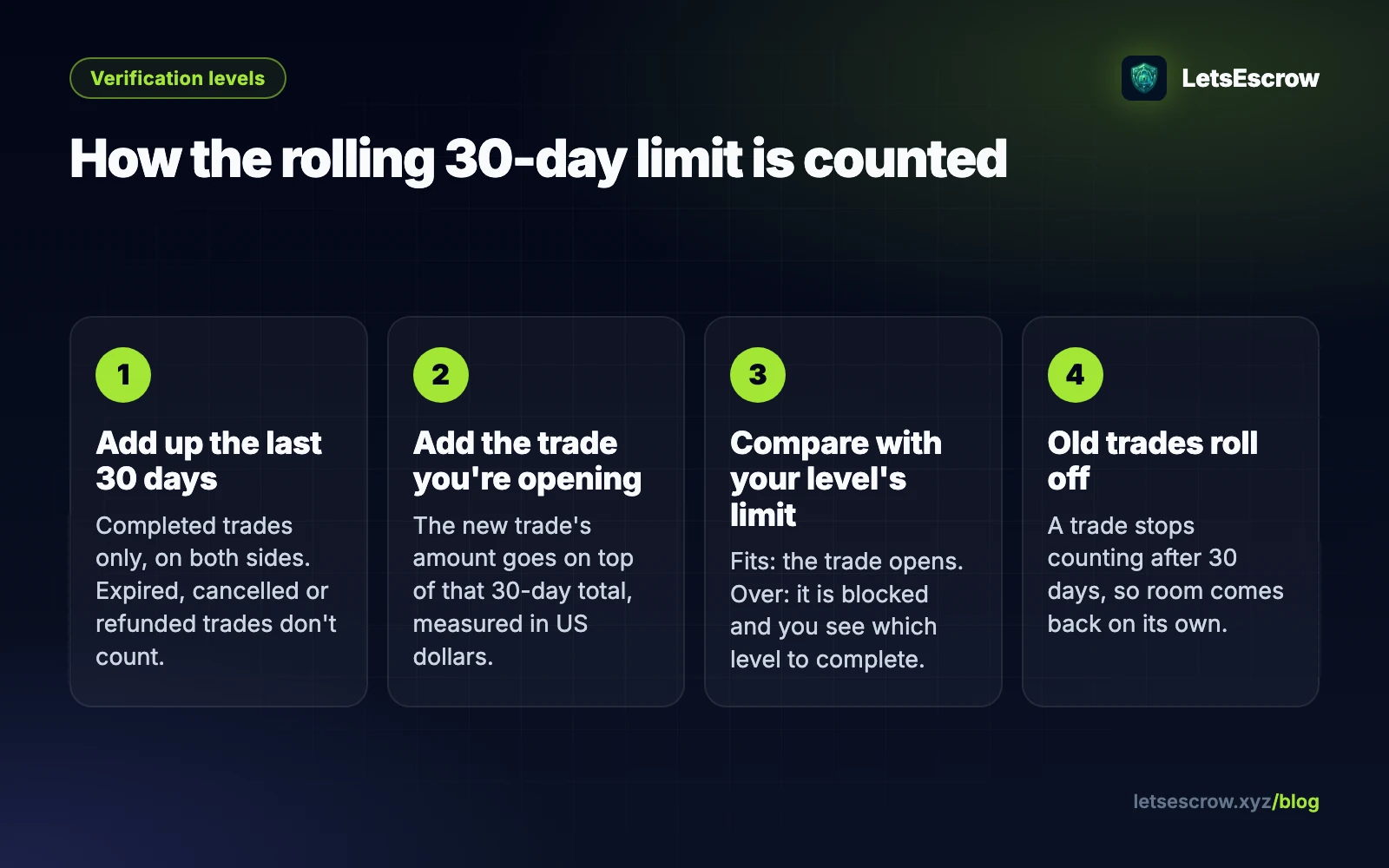
The limit is not per trade and not per calendar month. It is a rolling total, measured in US dollars.
When you try to open a trade, LetsEscrow adds up the completed trades on your account from the past 30 days, adds the trade you are about to open, and compares the total with your level's limit. If the total fits, the trade opens. If it doesn't, the trade is blocked and you are told which level to complete to continue.
Three details matter:
- Only completed trades count. A trade that expired, was cancelled or was refunded does not use up your limit.
- Both sides count. Trades where you paid and trades where you were paid both go into the total.
- Old trades roll off. A trade stops counting once it is more than 30 days old, so room comes back gradually.
A worked example (illustrative)
The amounts and dates here are invented.
Zainab is at Level 0, with the default $1,000 limit. On 2 November she completes a 400 USDT trade selling a gift card. On 10 November she completes a 350 USDT trade buying USDT by bank transfer. On 20 November she tries to open a 300 USDT trade.
- LetsEscrow adds her last 30 days: 400 + 350 = 750.
- It adds the new trade: 750 + 300 = 1,050.
- That is over $1,000, so the trade is blocked, with a message pointing her to Level 1.
Zainab has two choices. She can verify her phone number, which takes her to the Level 1 default of $5,000, and open the trade straight away. Or she can wait until early December, when the 2 November trade rolls out of the window. Then her total would be 350 + 300 = 650, under the limit.
If she had opened a 250 USDT trade instead, the total would have been exactly 1,000, and it would have gone through.
When verification comes early, whatever your level
The levels are the normal path. There is also an exception, and it is part of the deal.
If an account trips a fraud flag, or something about its trades looks suspicious, staff can require verification before that account trades again. Until it is completed, the account cannot open new trades, whatever its level and whatever room is left in its limit.
This is the honest version of "no KYC". You can start without documents and stay that way for everyday amounts. You cannot use that as cover. If your account starts behaving like a fraud pattern, the platform can stop and ask who you are.
For most traders this is good news. The person on the other side of your trade is under the same rule.
6 security tools that matter more when there's no passport on file
Low-ID trading only helps if your account is hard to take over, and phishing does not take days off. APWG observed 1,069,681 phishing attacks in Q2 2026, up 10.1% on the quarter before (APWG, 2026). Account takeover is its own line in the FBI's figures too: one tracked scheme, criminals posing as a bank's support team, produced about 4,700 complaints and $359.7 million in losses in 2025 (FBI IC3, 2025). LetsEscrow has several tools for keeping your account yours, and some for privacy as well.
- Authenticator 2FA. Two-factor authentication for your account using an authenticator app.
- Release codes. You can require an authenticator code or an emailed code before any release from your account goes through, so an open browser tab is not enough to move your money.
- IP allowlist. You can restrict your account to IP addresses you choose. If you lock yourself out, there is a recovery route by emailing the security team from your registered address.
- Active sessions. A list of where you are logged in, with the option to sign out any session you don't recognise.
- Password reset by email, Telegram bot, or both.
- A Tor mirror. LetsEscrow can also be reached over Tor, using the same account and the same balances as the regular site.
The interface is available in ten languages, including Hindi, Arabic, Chinese, Spanish and Portuguese. For more on these tools, see the LetsEscrow features page and the security section of the user guide.
ID first, ID never or ID in steps: the trade-off, compared
People searching for a no KYC P2P crypto exchange are usually reacting to the other extreme: many P2P platforms require a full ID upload before the first trade. That approach has a reason behind it: it makes fraud harder from day one, and there is plenty of fraud to make harder. In 2025 the FBI received 181,565 complaints that mentioned cryptocurrency, with more than $11.3 billion in reported losses (FBI IC3, 2025). The same approach also asks someone selling a 50 dollar gift card to hand a passport scan to a website they found yesterday.
LetsEscrow asks in steps instead. The bigger your monthly trading, the more it asks, and it keeps the option to ask early if a trade looks wrong. Meanwhile the escrow itself, available from Level 0 with no ID documents, does much of the protective work for small trades. The payer's crypto is locked before anything is delivered, only the payer or a moderator can release it, and disputes go to a human. You can read how that works in how P2P crypto escrow works.
Here are the three approaches side by side, including where the others are the better fit.
| Approach | ID to start | Funds locked during the trade | If something looks wrong | Where it is actually fine |
|---|---|---|---|---|
| Full ID before the first trade | A full ID upload | Usually, if the platform uses escrow | The platform already knows who you are | Large, regular trading, when you are happy to verify once |
| No platform: trading in DMs or groups | None | No | Nothing and nobody steps in | Small swaps with people you know well |
| LetsEscrow: ID in steps | A confirmed email (Level 0) | Yes: the payer's crypto locks when the trade opens | Staff can require verification before the account trades again | Everyday amounts with strangers, with checks added as your volume grows |
None of the three removes risk. This one simply matches the checks to the amount at stake, which is why P2P trading with no KYC can stay practical for everyday amounts.
FAQ
Can I buy USDT without KYC?
Yes, for everyday amounts. At Level 0 you can buy up to the default $1,000 in completed trades per rolling 30 days with only a confirmed email. The guide to buying USDT with a bank transfer walks through a trade step by step.
What happens if I exceed my limit?
The trade that would take you over is blocked before it opens, and you are told which level to complete. Nothing is frozen and no money is locked. Verify the next level, or wait for older trades to roll out of the 30-day window.
Is Level 1 just a phone number?
Yes. Level 1 adds a verified phone number to your confirmed email, and raises the default limit to $5,000 per rolling 30 days.
Can my account be forced to verify?
Yes. If an account trips a fraud flag or a trade looks suspicious, staff can require verification before it trades again, whatever its level.
Are the limits per trade or per month?
Neither exactly. The limit is a rolling 30-day total of your completed trades plus the trade you are opening. Single trades are also bound by each listing's own minimum and maximum.
The quickest way to understand the levels is to try them with no money at stake in the simulator. When you are ready, open a free account with an email address and start at Level 0.
LetsEscrow is a peer-to-peer escrow marketplace, not a bank, law firm or licensed escrow agent. Check the rules that apply where you live.