Proxy Buying Service: 5 Costs, 4 Proofs and 1 Sold-Out Plan for Items From Japan, the US or the UK
A proxy buying service is a person in Japan, the US or the UK who buys the item as a local and posts it to you. The 5 costs, how to pay without paying blind, and what to agree before a limited run sells out.
The fountain pen you want is a limited run from a Tokyo stationery shop. Its website is in Japanese, it only ships inside Japan, and the checkout wants a Japanese phone number. That is three locked doors before you have even picked a colour, and exactly what proxy buyers exist for. This guide explains how a proxy buying service works when the proxy is a person rather than a company, what is different about buying from Japan, the US and the UK, and how to pay a proxy without sending the money blind.
Proxy buying vs forwarding vs a friend: who buys, who pays, who's exposed
Buying from abroad is ordinary now. In Eurostat's 2023 figures, 20.05% of EU residents who shopped online in the previous three months had bought from sellers outside the EU (Eurostat, 2023). The routes for doing it get mixed up, though, and they solve different problems.
- Forwarding gives you an address in the store's country. You buy the item yourself and the forwarder sends the parcel on. It works when the only barrier is the delivery address.
- Proxy buying means someone in that country buys the item for you with their own account, card and address, then posts it to you. It works when the store also rejects foreign cards, needs a local phone number, or sells only in person.
- A buy-for-me friend is proxy buying with someone you already know. It is cheap and informal until something goes wrong and the friendship carries the cost.
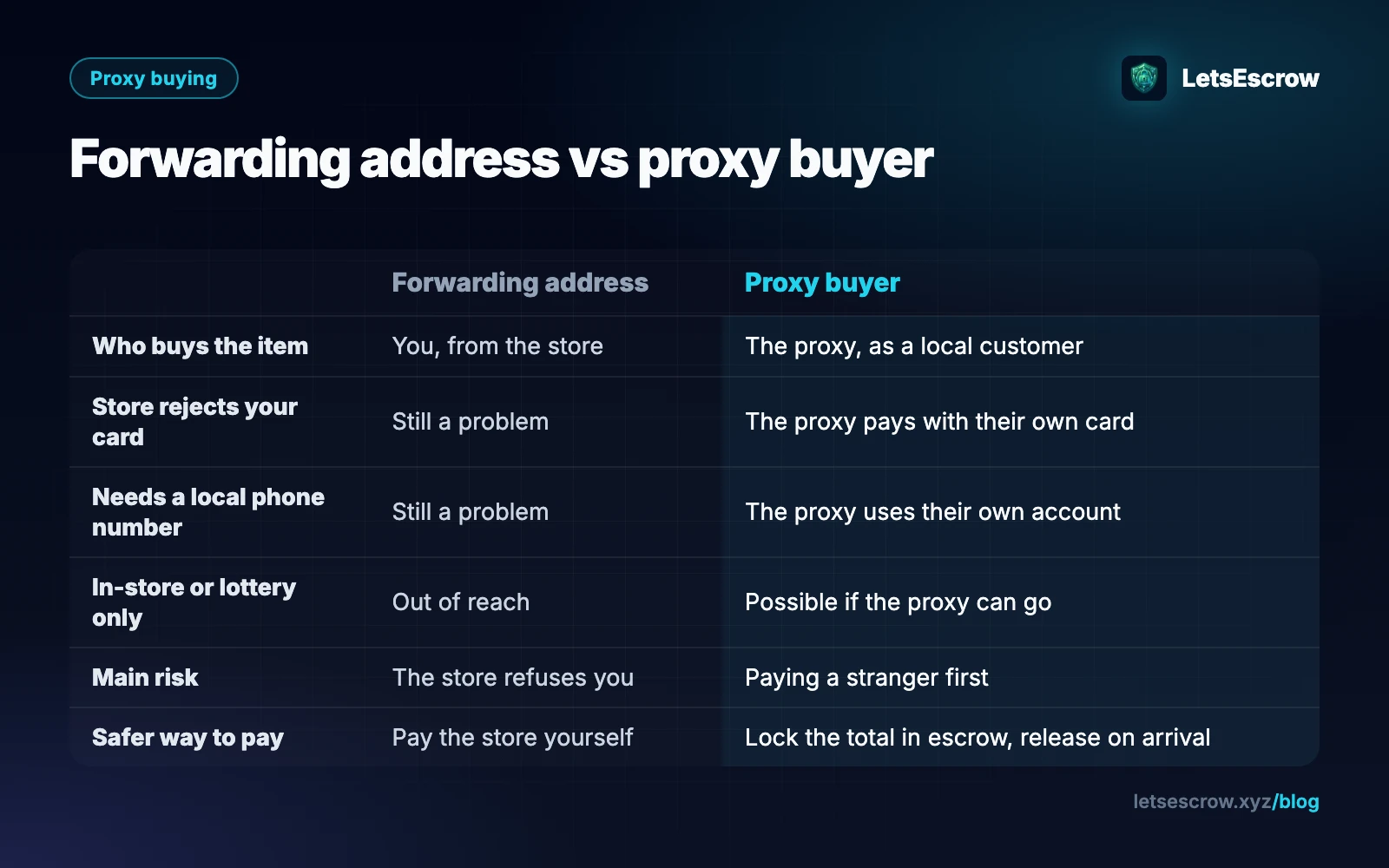
We compared these routes in more depth in how to buy from a website that won't ship to your country. This article focuses on proxy buying itself.
What it costs
Proxy costs are usually made of the same parts, even when the numbers vary:
- the item price, including any local sales tax,
- domestic shipping from the store to the proxy,
- the proxy's fee, either flat or a percentage,
- international shipping from the proxy to you,
- import charges in your country, paid on arrival.
Ask any proxy for a breakdown of the first four before you agree a total. The fifth is between you and your customs service.
Japan: domestic-only stores, auctions, and limited runs gone by lunch
Japan is the classic market for a proxy buying service. Many shops sell only to domestic addresses. Some need a Japanese phone number or local payment method. Auction and second-hand sites are often built for local buyers. Limited releases can sell out in hours, sometimes only in a physical shop or through a lottery.
A proxy in Japan can deal with all of that, but only if you give them clear instructions. Before you agree anything, prepare:
- The exact link to the item, not a photo from social media.
- Variant details: size, colour, edition, and the model or product code if there is one.
- A budget ceiling for the item, so a price change at checkout doesn't need a back-and-forth.
- Your fallback: if it's sold out, cancel or pick an alternative you name in advance.
- For auctions: your maximum bid, and what happens if you lose.
US and UK: 4 traps (exclusives, sale timing, sizing, tax)
US and UK proxies tend to handle different problems from Japanese ones.
Store exclusives
Some colours, collaborations and bundles are sold only by a single retailer or only in one country. A US proxy buying service, or a proxy in the UK, can buy them as a local customer would.
Sales timing
Big sales such as Black Friday in late November bring deep discounts that are often limited to domestic customers. Agree with your proxy before the sale starts: which items, which ceiling, and what to do if stock runs out.
Sizing
US, UK and EU sizes differ for shoes and clothing, and they are easy to mix up in a hurry. Write the size in the store's own system and ask the proxy to photograph the size label before shipping.
Tax and customs basics
US prices usually exclude sales tax, which varies by state. UK prices usually include VAT. Whether any tax can be reclaimed on an item leaving the country depends on the store and the rules, and an item bought domestically by a proxy is a different case from a store exporting it. Your own country may charge import duty or tax on arrival. Nothing here is tax or customs advice, so check the rules where you live before you order.
How a proxy buying service works with escrow: lock it, don't send it
A proxy is spending their own money on your item, so they ask for the item price plus their fee upfront. That is fair. Sending it to a stranger is still the riskiest step in the whole process. Paying first and receiving nothing, or something worse than described, is exactly what the FBI files as non-delivery. Together with non-payment, that category drew 56,478 complaints and $503,373,587 in reported losses in 2025 (FBI IC3, 2025).
Here is how the usual ways of paying a proxy compare.
| How you pay the proxy | When the proxy can spend it | If it sells out | If nothing ships | Where it is actually fine |
|---|---|---|---|---|
| Bank transfer upfront | Straight away | You ask for a refund and wait | Hard to recover from a private person abroad | A proxy you have used many times |
| Friends-and-family app payment | Straight away | You ask for a refund and wait | Built for paying people you know, so purchase protection usually does not apply | A friend abroad doing you a favour |
| Card payment to a proxy company | Under the company's terms | The company's refund policy | The company's terms, and possibly a dispute with your card issuer | Big-name stores the company already covers |
| Escrow trade on LetsEscrow | Only after you release | The proxy cancels and your crypto returns | Not marked delivered: it returns when the window ends. Otherwise a moderator decides | An individual proxy you found yourself |
The verdict: a proxy company is often the easier choice for big-name stores it already covers, and a friend is fine if you would forgive them the loss. For an individual proxy you met online, lock the money instead of sending it.
With escrow, you lock the money instead of sending it. When a trade opens on LetsEscrow, your crypto moves from your available balance to a locked balance. The proxy can see the trade is funded before they spend a yen. You keep the release, and only you can give it; the proxy cannot pay themselves.
The flow looks like this:
- You lock the agreed total in USDT or Bitcoin.
- The proxy buys the item and posts the receipt in the trade chat.
- They ship it and post the tracking.
- When it arrives and matches the order, you release.
If you haven't used escrow before, read how P2P crypto escrow works first. If you would like to see the trade screen without money involved, run a practice trade in the simulator.
What to put in the trade: 5 lines in your first message
Proxies usually list under "Do Shopping" or "Any Item from Any Website". You can browse personal shopping listings to see how they describe the stores and countries they cover. Listings can be priced in 26 currencies, including JPY, USD and GBP, so you can agree the total in the proxy's currency while USDT or Bitcoin is what gets locked.
Day to day, how a proxy buying service works for you comes down to how clearly you write the order. Your first message in the trade chat should hold all of it:
- the item link and variant details,
- the budget ceiling for the item,
- the shipping method and your address,
- who carries the risk if customs holds or returns the parcel,
- the release condition: "I release when the parcel arrives and matches this message."
The window
The listing sets a countdown of up to 24 hours on each trade. If the proxy hasn't marked the trade delivered when it ends, the trade cancels and your crypto returns to you. Agree that the proxy buys within the window, posts the receipt, and then clicks "service delivered". After that the timer no longer cancels the trade, and it waits for your release. Nothing is released automatically.
If the item has sold out, the proxy can cancel the trade, and your locked crypto goes back to your available balance. As the payer, you can't cancel, so agree the sold-out plan before you fund.
The 4-link proof chain (a tracking page saying "delivered" isn't one)
The trade chat takes image attachments, and everything posted there is timestamped. Build a chain of proof the proxy adds to at each step:
- Receipt or order confirmation with the item and price visible.
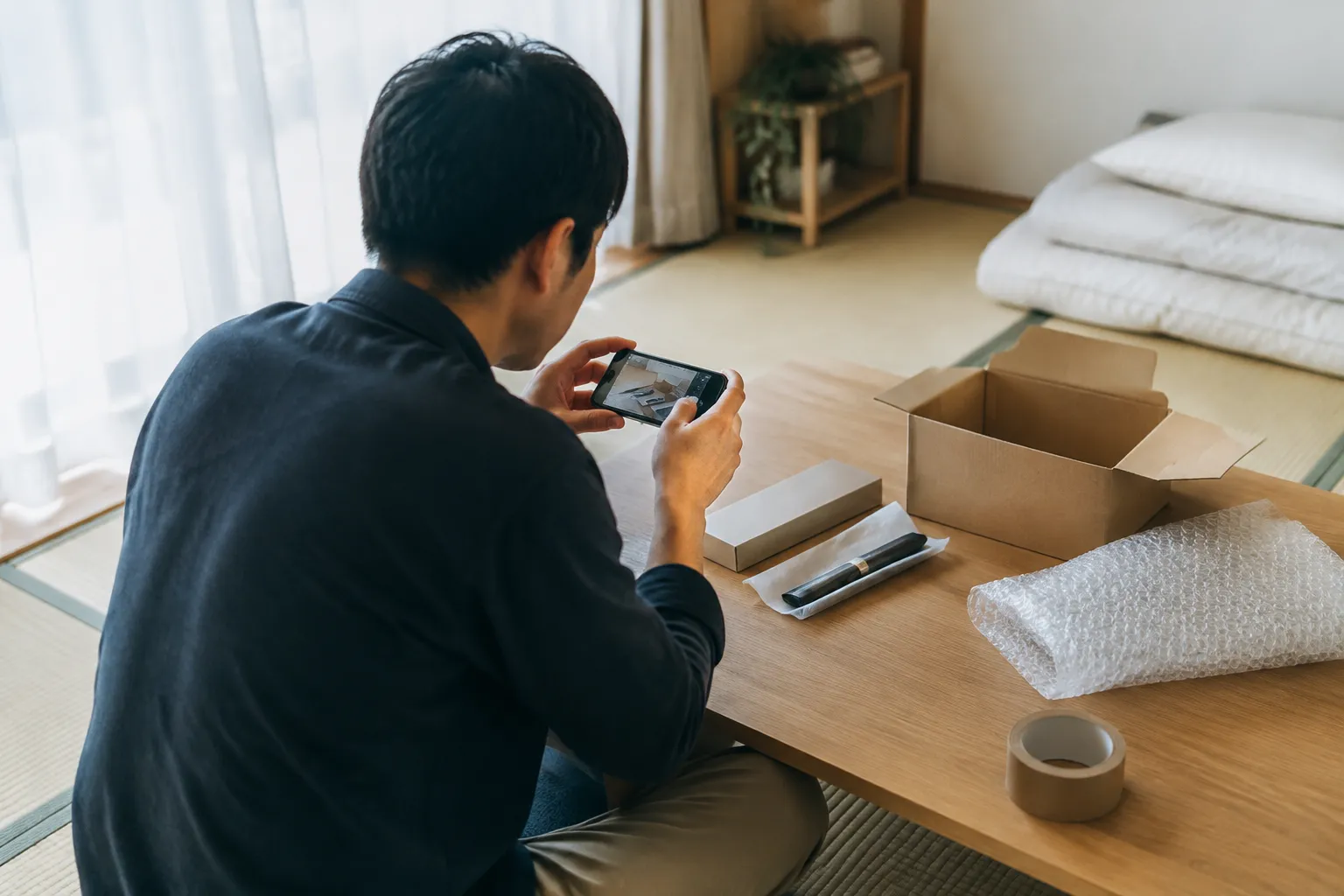
- Photos on arrival at the proxy: the item, the size label, the box.
- Shipping receipt and tracking number.
- Your photos on arrival, ideally as you open the parcel.
The chain earns its keep because delivery is where online orders most often wobble. In Eurostat's 2025 survey of EU online shoppers, 10% received a wrong or damaged item and 6% found complaints and redress difficult (Eurostat, 2025). Those figures cover domestic and cross-border orders together.
Keep all of it in the trade chat, not in a messaging app. A moderator reads only the trade, which is why moving a deal to WhatsApp is a red flag. "Delivered" means the parcel is in your hands and matches your first message. A tracking page that says delivered is not the same thing.
When it goes wrong: what a moderator decides, and what customs decides
LetsEscrow holds the payment. It does not buy, ship, insure or inspect anything, and it cannot get a parcel back from a carrier or customs. What a moderator can do, in a dispute, is decide what happens to the money.
If the wrong item arrives, it is damaged, or nothing arrives, don't release. Post your photos and open a dispute while the trade is live. The trade freezes, neither side can cancel, and a moderator reviews the chat, the proof chain and the timestamps. They can release the full amount to the proxy, refund you in full, or split it.
Customs problems are where your first message earns its keep. If customs holds or returns a parcel, the moderator can only go by what you both agreed about that risk in the chat. Without that line, it is your word against theirs.
Worked example (illustrative): a 24,000-yen pen, Osaka to Bengaluru
The people, prices and timings are invented.
Divya in Bengaluru wants that limited-run pen. She finds Haruto, a proxy in Osaka with a Do Shopping listing priced in JPY, a solid trade history and a 24-hour window. They agree on 24,000 yen: 18,000 for the pen, 2,000 for Haruto's fee, 4,000 for tracked international shipping.
- Lock. Divya opens a trade for 24,000 yen. The USDT equivalent, plus her half of the fee, locks.
- Order. Her first message has the link, the colour, a ceiling of 19,000 yen, tracked shipping, "if sold out, cancel", and her release rule.
- Purchase. Haruto orders the same day, posts the confirmation and marks the trade delivered.
- Proof. The pen reaches Haruto. He posts photos, ships it and adds the tracking number.
- Release. It reaches Divya. She checks it, posts a photo and releases.
If the pen had sold out, Haruto would have cancelled and Divya's USDT would have gone back to her balance.
FAQ
What is a proxy buyer, and is it the same as a proxy shopping service?
A proxy buyer is a person in the store's country who buys the item for you with their own account and posts it on. A proxy shopping service usually means a company doing the same for a fee. This guide covers the person version, which is what the Do Shopping listings are.
How much does a proxy buyer charge?
It varies by proxy, country and item. Some charge a flat fee, others a percentage. Ask for a breakdown of item price, domestic shipping, their fee and international shipping, and compare a few listings.
Can I use a proxy for auction sites?
If the proxy offers it, yes. Agree your maximum bid in the chat and open the trade close to when the auction ends, so it fits the 24-hour window. If you lose, the proxy cancels and your crypto is returned.
What if customs holds my parcel?
Escrow can't release a parcel from customs. Deal with your customs service directly, and agree before shipping who carries that risk. A moderator will go by what the chat says.
How do I pay a proxy buyer in Japan from Nigeria?
Agree the total in yen, then lock USDT or Bitcoin in the trade. If you only hold naira, you can first buy USDT with a bank transfer from another user.
Is proxy buying legal?
That depends on what you are buying and where it is going, and LetsEscrow can't advise on it. Some items are restricted for import in some countries. Check your country's customs rules and the store's terms before you order.
If you have an item in mind, browse live listings for proxies in that country, or create a free account and post what you are looking for.
LetsEscrow is a peer-to-peer escrow marketplace, not a bank, law firm or licensed escrow agent. Check the rules that apply where you live.