Hire a Lawyer Online Abroad: 4 Checks Before You Fund, and the 1 Thing Escrow Can't Judge
She wants the fee upfront; you want the contract review first. How to hire a lawyer online in another country: wire vs card vs escrow, 4 checks before you fund, and what a moderator can (and can't) rule on.
You found a lawyer in Lisbon who will review your distribution contract for 300 euros. She wants the money first. You want the review first. You haven't met, you are in different countries, and a wire to a firm you found online is hard to undo. This guide covers how to hire a lawyer online in another country and how to pay a lawyer you have never met without paying blind: lock the fee in escrow for a clearly defined piece of work, and release it when that work arrives. It also covers what escrow cannot do, which matters more here than in most trades.
Why paying a lawyer abroad is hard, and 4 ways people do it
Buying professional services across borders is not unusual. The WTO puts 2025 global exports of digitally delivered services, a category that includes professional services alongside financial and computer services, at US$5.26 trillion, up 10% (WTO, 2026).
Legal work has a pay-first culture. Many lawyers ask for a retainer before they open a file, and for good reason: clients who disappear after receiving advice are common. When the lawyer is in another country, the client's position gets worse. You are wiring money to an account you can't verify, under a legal system you don't know, and if the work doesn't arrive you have no practical way to chase it.
That gap is also where the attorney retainer scam lives. Someone with a convincing website asks for a "retainer" to start work on a visa, an inheritance or a contract, and then goes quiet. The ask itself is normal, which is what makes it effective. Pretending to be someone you are not is a well-worn script: the FTC received over 1 million reports about imposter frauds from US consumers in 2025, with reported losses of over $3.5 billion (FTC, 2026).
Not all legal work suits escrow. Open-ended representation, court cases and anything billed by the hour over months are hard to fit. What fits well is fixed-fee work with a defined deliverable: a contract review with written comments, a drafted agreement, a written opinion on a specific question. That is the subset this guide is about.
Here is how the usual ways of paying a lawyer abroad compare.
| How you pay | When the money moves | If the work doesn't arrive | Who checks the lawyer | Best fit |
|---|---|---|---|---|
| Bank wire retainer, upfront | Before any work | Hard to recover across a border | You | A firm you have verified and worked with before |
| Card payment on the firm's invoice | When you pay the invoice | You may be able to dispute it with your card issuer | You | Established firms that take cards |
| A friend's recommendation, paid upfront | Before any work | Depends on the lawyer, and on your friend's judgement | Your friend, informally | Small matters, when your friend has used them |
| Escrow trade on LetsEscrow | Locked before work starts, released by you after delivery | Not marked delivered: the fee returns. Otherwise a moderator can release, refund or split | You. LetsEscrow does not check credentials | Fixed-fee work with a defined deliverable |
The verdict: for ongoing representation, court work or hourly billing, the firm's normal engagement and invoicing process is the better route. Escrow fits the fixed-fee slice: a review, a draft, an opinion.

What escrow protects (the fee) and what it can't (the advice)
Be clear on this before you go further.
Escrow protects the payment. Your fee is locked before the lawyer starts, using the same mechanics described in how P2P crypto escrow works. They can see it is real. You release it when the agreed deliverable exists. If it doesn't arrive, you are not out of pocket. If you disagree about whether it arrived, a moderator decides.
Escrow does not protect the quality of the advice. A moderator can check whether you received a review with written comments, as agreed. A moderator cannot tell you whether those comments are good law.
LetsEscrow does not check credentials. It is a peer-to-peer escrow marketplace, not a law firm or a legal services provider, and it does not verify that anyone is a qualified or registered lawyer. A profile shows how someone has traded on the platform. It says nothing about their professional standing.
4 checks before you fund, because the platform doesn't make them
Because the platform doesn't check, you have to. Do this before you lock anything.
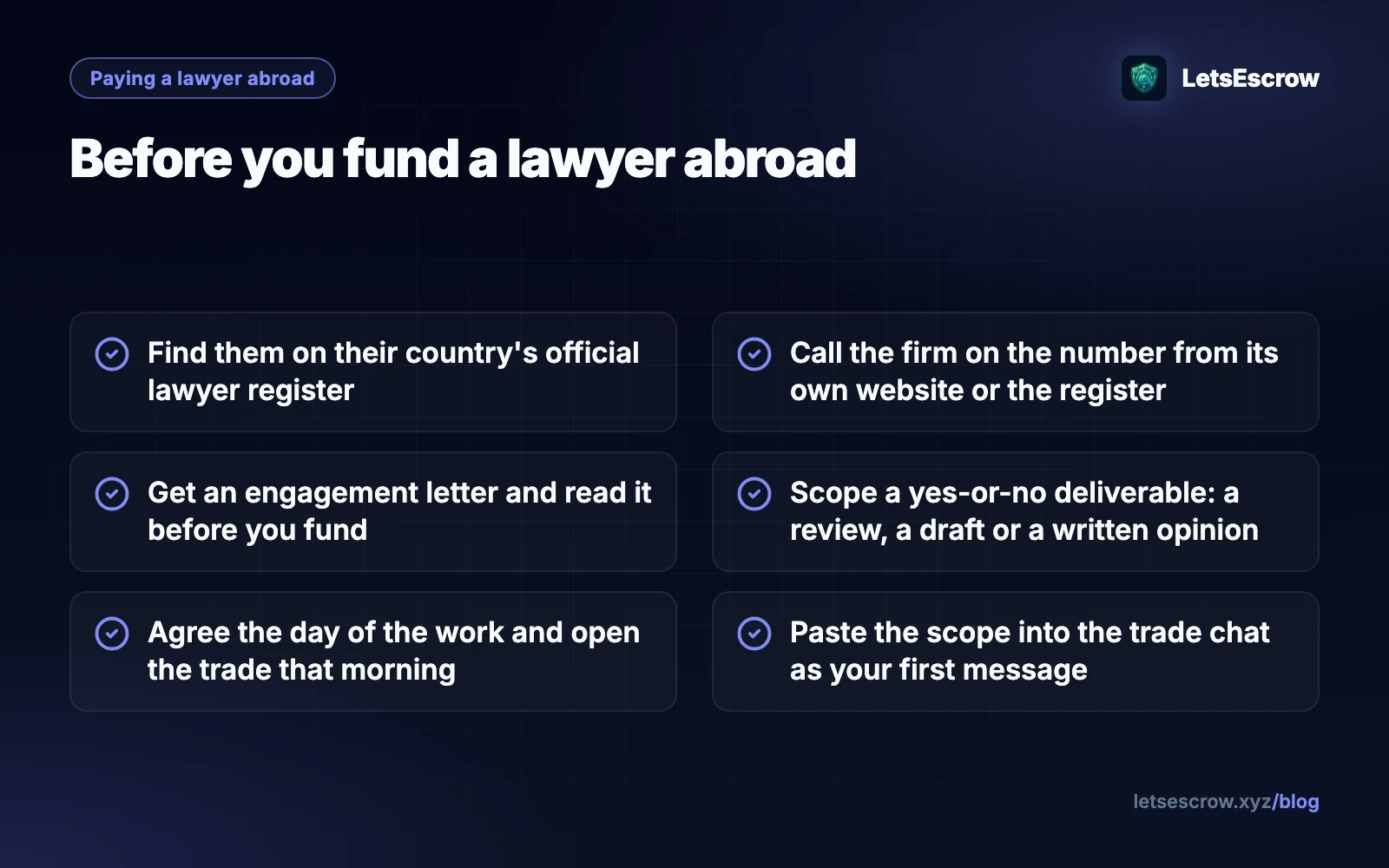
- Find the official register. Many countries have a public register of lawyers, usually run by the bar association or law society. Search for the lawyer's name and registration number there, not on a site they sent you.
- Contact the firm independently. Use the phone number or email on the firm's own website, or on the register, and confirm the person works there.
- Ask for an engagement letter. A real lawyer will usually set out the scope, the fee, confidentiality and who the client is in writing. Read it before you fund.
- Read the platform profile for what it is. Completed trades, rating, trusted-by count and verification level tell you about payment behaviour. The verification level relates to identity and trading limits, not to a law licence.
If any of these checks fails, or the person resists them, stop. A genuine lawyer expects to be checked.
Scoping legal work: turn "legal help" into a yes-or-no deliverable
Most of the answer to how to pay a lawyer in another country comes down to scope. The key to using escrow for legal fees is turning "legal help" into a deliverable you can answer yes or no to. Good examples:
- "Review of the attached 14-page distribution agreement, with comments in the margin and a one-page summary of the main risks."
- "A drafted mutual NDA under Portuguese law, based on the term sheet in this chat, as an editable document."
- "A written opinion, two pages maximum, answering this question: can the supplier end the contract early under clause 9?"
Write down the format (document type, length), how many follow-up questions are included, and what "delivered" means. Paste it into the trade chat as your first message so it sits on the record.
Fit it to the window
A LetsEscrow trade has a countdown of up to 24 hours. If the lawyer hasn't marked the work delivered when it ends, the trade cancels and your fee returns to your balance. So agree the day the lawyer will do the work, and open the trade that morning. For a larger matter, split it into separate trades, one per document or question. LetsEscrow has no milestone feature, so each piece is its own trade with its own release.
The services hub has more on this approach in how to pay a freelancer or consultant without paying upfront. The same five-line method works for legal work.
Setting up the trade: 2 ways in, 26 currencies, 1 confidentiality question
There are two ways in, and in both your crypto is what gets locked:
- The lawyer lists a service under "Legal, Accounting & Bookkeeping", which covers contract reviews and similar work, or under Custom with a title like "Contract review, written comments". You open a trade on it.
- You post a hire listing describing the work, and the lawyer opens a trade on it. As the payer, your wallet must cover at least the listing's minimum trade before it goes live.
International lawyer fees can be priced in any of 26 currencies, including EUR, GBP, USD and AED, so the fee can be agreed in the lawyer's currency. The money locked is USDT or Bitcoin at the live rate. You can see how others describe this work in the contract review listings and the accounting and bookkeeping listings.
One more consideration for legal work. The trade chat is sent over HTTPS and stored on LetsEscrow's servers. It is not end-to-end encrypted, and moderators read it if there is a dispute. Ask the lawyer how they want to handle confidential documents, and put in the chat what is needed to define and prove the deliverable.
Fund, deliver, inspect, release: 4 steps and 1 cancel button (the lawyer's)
- Fund. Deposit USDT or BTC to your LetsEscrow wallet ahead of time. Deposits are approved by staff, so don't leave it to the last minute. When you open the trade, the fee plus your half of the platform fee moves to locked.
- Deliver. The lawyer does the work, posts the document or a link to it in the trade chat, and clicks "service delivered" with notes. From then on the timer can't cancel the trade.
- Inspect. Check the deliverable against your first message. Is it the agreed document, in the agreed format, covering the agreed question?
- Release. Only you can release. The lawyer receives the fee minus their half of the platform fee in their LetsEscrow wallet. You can require an authenticator or email code before any release, so nobody else can release from your device.
Remember one limit before you fund: as the client, you cannot cancel a funded trade. Only the lawyer can cancel, which returns your fee. Your other options are to wait for the window to run out, if nothing was delivered, or to open a dispute. To see each of these screens without money involved, run through a practice trade.
Missing pages or bad law? A moderator can rule on only one of them
Disputes over legal work should be about scope, not about whether you like the advice. "I asked for comments on all 14 pages and received comments on 3" is a scope dispute. "I disagree with her reading of clause 9" is not something a moderator can decide. For that you need a second lawyer, not a referee.
Both of you can raise a dispute at any point up to release. The trade freezes, neither side can cancel, and a moderator reviews the chat, the deliverable and the timestamps. They can release the fee to the lawyer, refund you, or split it, for example if half of the agreed documents were delivered. There is no promised response time.
Hire a lawyer online, pay through escrow: 300 EUR, 14 pages, Toronto to Lisbon (illustrative)
The people and amounts below are invented.
Callum runs a small coffee importer in Toronto and is about to sign a distribution deal with a Portuguese company. He finds Inês, a commercial lawyer in Lisbon, who quotes 300 EUR for a review.
- Checks. Callum finds Inês on the Portuguese bar's public register, then calls her firm on the number from its own website. She sends an engagement letter, which he reads and signs.
- Scope. They agree: margin comments on the 14-page agreement, a one-page risk summary, one round of follow-up questions in the chat, delivered on Thursday.
- Trade. Inês has a Legal, Accounting & Bookkeeping listing titled "Contract review, written comments", priced in EUR, with a 24-hour window. On Thursday morning Callum opens a trade for 300 EUR. The USDT equivalent plus his half of the fee locks. He pastes the scope as his first message.
- Delivery. That afternoon Inês posts the annotated contract and summary and marks it delivered. Callum asks two questions, she answers both, and he releases with his authenticator code.
If she had sent only the summary, Callum would have opened a dispute, and the moderator would have compared his first message with what arrived.
FAQ
Can I pay a lawyer online with USDT?
On LetsEscrow, yes, if the lawyer agrees. Your USDT is locked in escrow and released to them when the work is delivered. Some lawyers can't accept crypto under their own professional rules, so ask first. If you don't hold USDT yet, you can buy USDT from another user with a bank transfer first.
Is LetsEscrow a legal services platform?
No. It is a peer-to-peer escrow marketplace. It holds the fee and provides the trade chat and dispute process. It does not provide legal advice, vet lawyers or take part in the lawyer-client relationship.
What if the lawyer wants a retainer or hourly billing?
Escrow fits fixed fees best, and a retainer paid upfront is exactly what it replaces: lock the fee for a defined task instead. If hourly is the only option, agree small blocks, such as one or two hours for a defined task, and run each block as its own trade.
Does escrow replace an engagement letter?
No. The engagement letter sets out the legal relationship, duties and confidentiality. Escrow only holds the payment. Use both, and copy the scope from the letter into the trade chat.
Can you hire a lawyer from another country?
Whether a lawyer abroad can act on your matter depends on where they are qualified and what the work is, and LetsEscrow can't advise on that. Check the official register in their country yourself, contact the firm through its published details, and ask what they are permitted to advise on. What escrow handles is the payment side. A LetsEscrow profile shows trading history, not professional credentials.
If you have found a lawyer, ask them to list their service, or browse live listings for legal and accounting work. When you are ready, create a free account with an email address.
LetsEscrow is a peer-to-peer escrow marketplace, not a bank, law firm or licensed escrow agent. Check the rules that apply where you live.