How P2P Crypto Escrow Works: 1 Rule, 5 Steps, and the Button the Payer Doesn't Get
Pay first and you carry the risk. Deliver first and they do. P2P crypto escrow swaps both for one rule. Here it is in 5 steps, with the usual alternatives side by side and a 400 USDT worked example.
You have agreed to pay a designer in Buenos Aires 400 USDT for a logo. He wants the money before he starts. You want the logo before you pay. One of you has to trust a stranger, and both of you are very politely not volunteering. This guide shows how P2P crypto escrow works on LetsEscrow, one trade at a time: who locks the money, who delivers, who releases it, and what happens when someone goes quiet.
For the basics of escrow in general, read the general guide to how escrow protects both sides of a deal. This one follows a single trade from deposit to withdrawal, which is the clearest way to see how crypto escrow works on a P2P marketplace.
How P2P crypto escrow works: 1 rule vs 5 other ways to settle who goes first
The crypto is locked before anything is delivered. Once it is locked, only the person whose crypto it is, or a moderator, can release it.
Everything else on a peer-to-peer escrow service, the countdown, the dispute button, the release code and the trade chat, exists to support that rule.
The rule exists because the usual alternative fails so often. In 2025 the FBI's Internet Crime Complaint Center logged 56,478 non-payment and non-delivery complaints, with $503,373,587 in reported losses (FBI IC3, 2025). Its definition covers both sides of the deal: goods or services sent and never paid for, and payment sent for goods or services that never arrived. And that is one category in a report that passed one million complaints for the first time: 1,008,597 in all, with $20.877 billion in reported losses. Those are only the complaints people filed, so the real totals are higher.
Here is how the common ways of settling "who goes first" compare. None of them is wrong every time.
| Option | Who carries the risk | If nothing is delivered | Where it is actually fine |
|---|---|---|---|
| Pay upfront by bank wire or crypto | The payer, all of it | Usually hard to recover. A crypto transfer to someone else's wallet cannot be pulled back by the sender | Someone you have paid many times before |
| Friends-and-family app payment | The payer | Built for paying people you know, so purchase protection usually does not apply | Splitting a bill with an actual friend |
| Deliver first, invoice after | The person delivering | They chase the invoice, or write it off | Repeat clients with a good payment record |
| A friend of a friend holds the money | Both sides, on one person's honesty | Depends on the friend, and on the friendship | Small amounts inside a close circle |
| Freelance or marketplace platform | Shared, under the platform's rules | The platform's own dispute process | Long contracts, hourly billing or milestones, which LetsEscrow does not offer |
| P2P crypto escrow on LetsEscrow | Shared: the money is locked and the release waits | Nothing marked delivered: the trade cancels when the window ends and the crypto returns. Otherwise a moderator decides | Strangers, one deliverable at a time, paid in USDT or BTC |
The verdict: with someone you already know and trust, the simple options are fine and cost nothing. With a stranger in another country, the lock is the point.
Who is who in this guide
The payer is whoever's crypto gets locked. The deliverer is the person who receives that crypto when the trade completes. Which side is which depends on the trade:
- Service trade: the client is the payer. The freelancer, lawyer or personal shopper is the deliverer.
- Gift card trade: the person buying the card with crypto is the payer. The card seller is the deliverer.
- Crypto-for-cash trade: the person selling USDT or BTC is the payer. The buyer sends a bank transfer, UPI payment or similar, and that payment is their delivery.
Cross-border shopping runs as a service trade. The mechanics below are the same for every type.

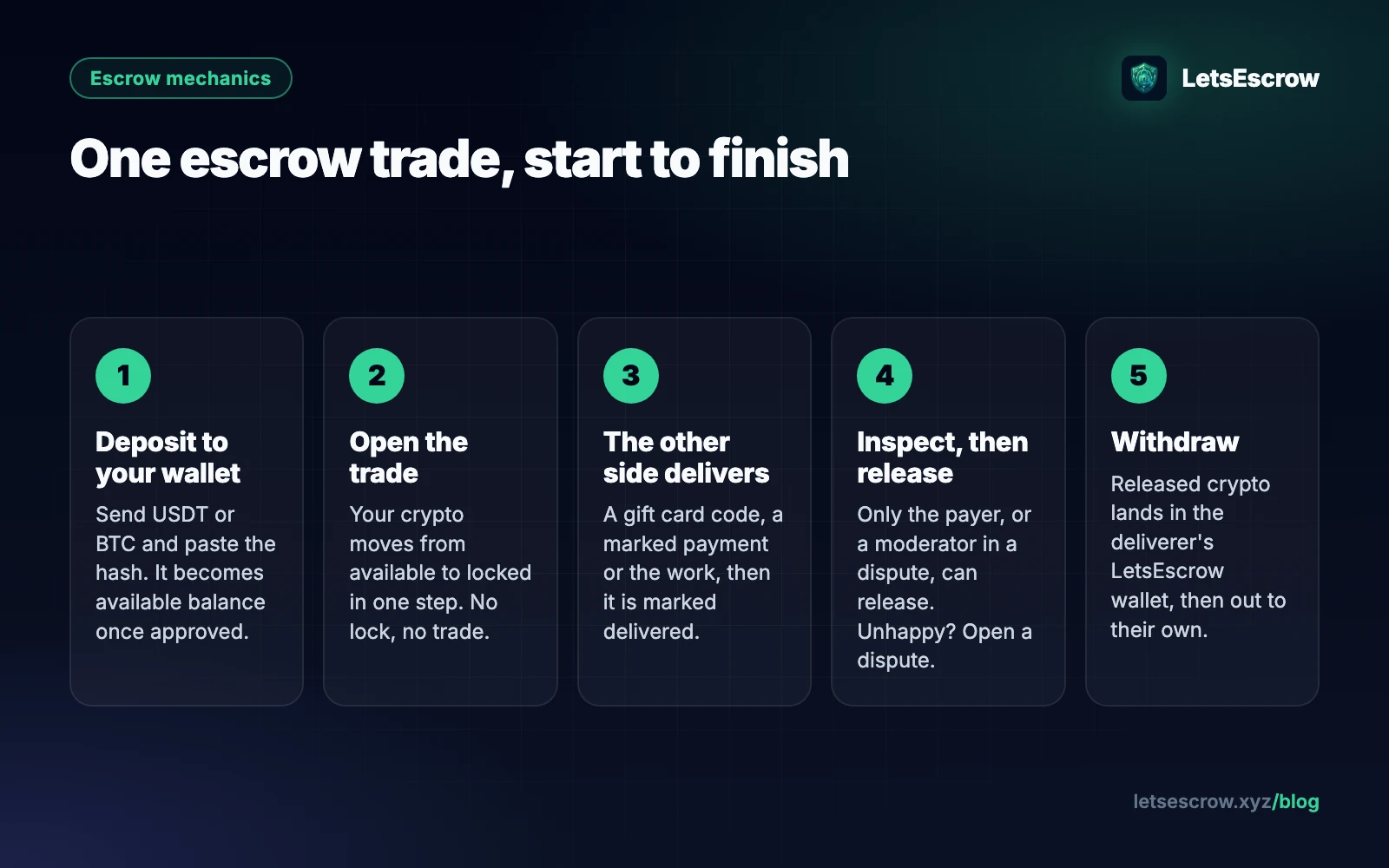
Step 1: fund your wallet before you need it (approval is manual)
A trade can only open if the payer already has crypto in their LetsEscrow wallet. Three assets are supported: USDT on TRON (called TRC20), USDT on BNB Smart Chain (called BEP20), and Bitcoin, so a Bitcoin P2P escrow trade runs exactly like a USDT one. TRC20 and BEP20 are two networks carrying the same dollar-pegged token, so pick the network first and use the deposit address shown for it. Stablecoins like USDT are what most person-to-person crypto moves in anyway: Chainalysis's 2026 Global Crypto Adoption Index found that transfers directly between personal wallets are now 96% stablecoins (Chainalysis, 2026).
- Choose the asset and network on your wallet page.
- Send the crypto from your own wallet or exchange account to the address shown.
- Paste the transaction hash (the transaction ID your sending wallet gives you) into the deposit form.
- Once the network confirmations arrive and staff approve the deposit, it shows as available balance.
Available balance is crypto you can trade or withdraw. Locked balance is crypto sitting inside an open trade.
Two honest details. Deposit approval is a manual step, so fund your wallet before you need it, not minutes before a deal. A deposit sent four minutes before a deadline is a lesson, not a plan. And LetsEscrow holds deposits in its own platform wallet: it is a custodial crypto escrow service, and the escrow is a balance on LetsEscrow's ledger, not a smart contract.
The deliverer does not need to deposit anything. Their payout lands in their LetsEscrow wallet when the trade completes.
Step 2: open the trade, and the crypto locks in one move
When a trade opens against a listing, two things happen in one step: the payer's available balance goes down and their locked balance goes up by the same amount. The trade starts in a funded state.
If the payer does not have enough available balance, the trade does not open. There is no "awaiting payment" stage where the deliverer starts work and hopes the money turns up. A trade exists only because the money behind it is already locked.
What gets locked, including the fee
The platform fee is split evenly. Half is added to what the payer locks, and half comes off what the deliverer receives. The percentage is set per crypto, shown before you confirm, and fixed when the trade opens, so a later rate change does not touch a running trade.
To see what the trade screen looks like before you put money in, practice a full trade with no money in the simulator. It covers opening a trade, the release code and a dispute.
Step 3: delivery, 3 ways: a code, a transfer or the work
What counts as delivery depends on the trade type.
Gift card trades
The card seller submits the code inside the trade. LetsEscrow compares it with codes from past trades and tells the buyer in the chat whether it has been seen before on the platform. That is a pattern match, not a balance check, so the buyer still checks the card. Browse the gift card offers to see how buyers and sellers word their terms.
Crypto-for-cash trades
The buyer sends the bank transfer or other payment, then marks the trade as paid with a reference number and, optionally, a screenshot. A screenshot is not proof that money arrived, so the seller checks their own bank app first. Each of the crypto-for-cash listings states its payment method and rules.
Service trades
The provider hands over the work, usually as files or links in the trade chat, and clicks "service delivered" with notes. The service listings show each provider's scope and delivery time.
In all three cases the trade moves to review, and a system message tells the payer to inspect and then release or raise a dispute. Marking delivery also stops the countdown from cancelling the trade.
Step 4: inspect, then release (or let a moderator decide)
This is where the payer's attention matters most. Redeem the card or check its balance. Look at your bank app, not the screenshot. Open the files and make sure they are the ones you asked for.
Releasing
Only the payer can release, apart from staff. The release button refuses anyone else, so the deliverer cannot pay themselves. On release, the deliverer's share is credited to their LetsEscrow wallet and both accounts get a completed trade added to their count.
You can require a second check before any release goes through: a 6-digit code from an authenticator app, a 6-digit code sent to your email, or both. Then an open browser tab on a shared computer is not enough to move your money.
Raising a dispute
Either side can open a dispute while the trade is funded, delivered or under review. You pick a reason, such as an invalid code, payment not received, off-platform solicitation, a reversed payment or an unresponsive counterparty.
A dispute freezes the trade, and neither side can cancel it after that. A notice goes into the trade chat, staff are notified, and the other party gets an email. A moderator reviews the chat, the evidence and the timestamps, then decides one of three outcomes:
- release the full amount to the deliverer,
- refund the full amount to the payer, or
- split it, by amount or by percentage.
There is no promised response time, so put your evidence in the trade chat early and keep it plain. A redemption error, a bank statement line or the brief you agreed carries more weight than a long argument. Disputes and release codes each have a section in the LetsEscrow user guide.
Who can cancel (not the payer) and what the countdown does
The deliverer can cancel. The payer cannot. If the freelancer, card seller or bank-transfer sender decides not to go ahead, they can cancel an open trade and the locked crypto goes back to the payer. The payer has no cancel button. Once you fund, your options are to wait for the timer or to open a dispute.
That sounds hard on the payer, but it protects the person doing the work. Without it, a payer could watch the work arrive, cancel, and keep both the work and the money. In design circles that is known as a free logo.
The countdown
Every trade has a window set by the listing owner, from 5 minutes up to 24 hours, with 30 minutes as the default. If it runs out and the deliverer has not marked the code delivered, the payment sent or the service delivered, the trade cancels itself and the locked crypto returns to the payer's available balance.
Once delivery has been marked, the timer no longer cancels the trade. From then on the payer releases or someone disputes.
Reopening an expired trade
If a trade expired by accident, either side can reopen it within the listing's reopen window (60 minutes by default), as long as the listing allows it and the payer still has the balance. The countdown starts again.
| Action | Payer | Deliverer | Moderator |
|---|---|---|---|
| Mark delivered | No | Yes | n/a |
| Release the crypto | Yes | No | Yes |
| Cancel an open trade | No | Yes, unless disputed | Can refund |
| Open a dispute | Yes | Yes | n/a |
| Decide a dispute | No | No | Release, refund or split |
| Reopen an expired trade | Yes | Yes | n/a |
Step 5: paid to a LetsEscrow wallet, then withdrawn: 2 separate steps
Released crypto goes to the deliverer's LetsEscrow wallet balance, not straight to an outside address. To move it out, save the wallet address you want to use and request a withdrawal. The withdrawal fee for that crypto is shown before you confirm. Staff process the request and record the transaction hash, so you can look it up on the blockchain yourself.
Inside the wallet you can also swap USDT between BEP20 and TRC20 one-for-one, or between USDT and Bitcoin at the live rate. No withdrawal time is promised, so don't build a plan that needs the coins within the hour.
Worked example (illustrative): a 400 USDT logo, Leeds to Buenos Aires
The people and numbers below are made up to show how P2P crypto escrow works in practice. They are not platform figures.
Nadia runs a small bakery in Leeds and wants a new logo. Joaquín, a designer in Buenos Aires, has a service listing on LetsEscrow: three concepts, one round of changes, and final files in SVG and PNG for 400 USDT. The job takes about a day, so his listing's window is 24 hours, the maximum.
- Deposit. Nadia sends 420 USDT on TRC20 to her deposit address and pastes the transaction hash. After approval it shows as available balance. The extra covers her half of the fee.
- Open the trade. 400 USDT plus her half of the fee moves from available to locked. Her first chat message repeats the brief, so it is on record.
- Work starts. Joaquín sees the trade is funded. He does not have to take Nadia's word that she will pay.
- Deliver. Next morning Joaquín posts three concepts in the chat. Nadia picks one and asks for a darker green. That afternoon he posts previews and a download link for the final files, then clicks "service delivered" with a note listing what is included.
- Inspect and release. Nadia opens both file formats, clicks release and enters her authenticator code. Joaquín's wallet is credited 400 USDT minus his half of the fee.
- Withdraw. Joaquín withdraws to his own wallet. The withdrawal fee is shown before he confirms.
Two other endings are worth knowing. If Joaquín had not marked delivery within 24 hours, the trade would have cancelled itself and Nadia's USDT would have returned to her available balance. If the files had been wrong, Nadia could have opened a dispute, and a moderator would have compared the brief in the chat with what arrived.
FAQ
Can the freelancer release the money themselves?
No. Release is refused for anyone except the account whose crypto is locked, or staff. The freelancer can mark the work delivered, or cancel the trade, which sends the money back to you. They cannot pay themselves.
What if I change my mind after funding?
As the payer, you cannot cancel a funded trade. If nothing has been delivered, it cancels itself when the window ends and your crypto returns to your available balance. You can also ask the other side to cancel. If they have delivered and you disagree about the result, open a dispute. That is why you agree the details before you fund.
What happens if nobody does anything for 24 hours?
It depends on whether delivery was marked. If not, the trade cancels when the window ends (24 hours is the longest a listing can set) and the payer gets the crypto back. If delivery was marked, the timer no longer applies and the trade waits in review until the payer releases or someone opens a dispute. A deliverer facing a silent payer can dispute with the unresponsive-counterparty reason.
How does a P2P crypto exchange work with escrow?
On a P2P exchange, two users trade crypto for a bank transfer or similar. With escrow in the middle, the seller's crypto locks when the trade opens, the buyer pays and marks the trade paid, and the seller releases after checking their own account. LetsEscrow runs those trades under its crypto-for-cash tab, and the same lock, deliver, release flow covers services and gift cards.
Is the escrow on-chain?
No. Deposits and withdrawals are ordinary blockchain transactions, but the lock itself is a balance on LetsEscrow's ledger. LetsEscrow holds the deposited funds, so you are relying on the platform's rule that only the payer or a moderator can release, not on a smart contract.
Do I need ID to open a trade?
Not for everyday amounts. An account with only a confirmed email can trade up to a default of $1,000 in completed trades over a rolling 30 days. Higher limits open up step by step, starting with a phone number. Staff can also ask for verification if a trade looks suspicious.
Now you know how P2P crypto escrow works on paper, run through it once in the simulator. When you are ready for the real thing, browse live listings to see real windows and terms, or open a free account with an email address.
LetsEscrow is a peer-to-peer escrow marketplace, not a bank, law firm or licensed escrow agent. Check the rules that apply where you live.