WhatsApp Crypto Scam: 5 Ways 'Let's Move Off-Platform' Gets Asked, and 3 Replies That End It
Almost every WhatsApp crypto scam opens the same way: "let's finish this off-platform". Why scammers need that move, what the trade chat does about it, a side-by-side table, and 3 polite ways to say no.
The trade is open and your USDT is locked. Then the other side writes: "Bro, add me on WhatsApp, easier to talk there. I can do a better rate." It sounds friendly. It is also the opening line of the classic WhatsApp crypto scam, and of its Telegram twin. Nothing that follows needs to be clever, because once the conversation leaves the trade, the protections go with it. This guide explains why scammers need that move, what LetsEscrow's trade chat does when someone tries it, and what to reply.
Why the WhatsApp crypto scam has to start off-platform: 3 things it can't beat
Messaging apps and social media are where a lot of scams begin. In the FTC's 2025 data, nearly 30% of people who reported losing money to a scam said it started on social media, with $2.1 billion in reported losses. Facebook topped the list of platforms, with WhatsApp and Instagram "a distant second and third" (FTC, 2026). Those are US reports.
Inside an escrow trade, a scammer has three problems.
- The money is locked. When a trade opens, the payer's crypto moves to a locked balance. The other side can't take it, and the payer can't pull it back on a whim either.
- There is a record. Every message, image and status change in the trade is timestamped and attached to that trade.
- There is a referee. If the two sides disagree, a moderator reads that record and can release, refund or split the money.
Off-platform, all three disappear. There is no lock, so they can ask you to send first. There is no record anyone else can check, so they can deny what was said. And there is nobody to decide, so whoever holds the money keeps it.
| Inside a LetsEscrow trade | Moved to WhatsApp or Telegram | |
|---|---|---|
| The money | Locked before anything is delivered | Whatever you send, the moment you send it |
| The record | Timestamped chat, attachments and status history, attached to the trade | A chat that only the two of you can see, and either of you can delete |
| The referee | A moderator who can release, refund or split | Nobody |
| Contact details shared | Warning shown, attempt logged, staff alerted | That was the whole point of the move |
| Good for | Deals with people you have never met | Talking to people you already know and trust |
WhatsApp and Telegram are fine apps for talking. They are just a poor place to pay a stranger.
That is why the request itself is the tell. A trader who is happy with the deal has no reason to move it. For the full picture of what the lock does, read how P2P crypto escrow works.

The 5 versions of the ask (plus 1 for service trades)
The wording of a peer to peer scam changes. The goal doesn't. Here are the five versions you will see most.
1. "I'll give you a better rate outside"
A slightly better price is the easiest bait, because it feels like a normal negotiation. A rate that beats every listing on the page usually means the trade is not meant to complete.
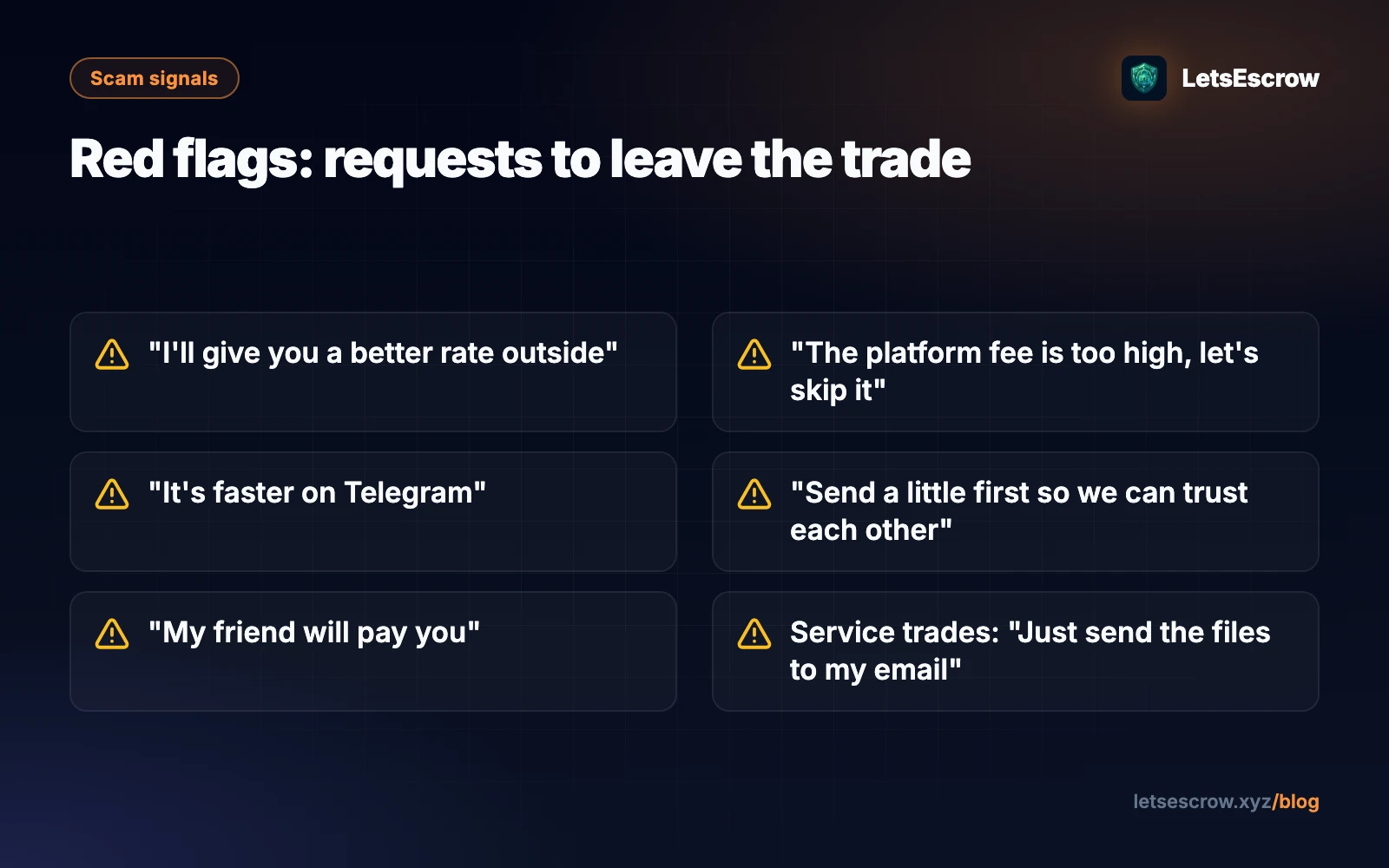
2. "The platform fee is too high, let's skip it"
This frames escrow as a cost instead of protection. On LetsEscrow the fee is split evenly and shown before you confirm. Skipping it means skipping the lock, the record and the moderator.
3. "It's faster on Telegram"
Urgency is the point. Speed pressure makes people skip checks: "My bank closes in ten minutes, just send it." Banks that close in ten minutes are remarkably common in these chats.
4. "Send a little first so we can trust each other"
The "test" payment or "test" gift card code. Sometimes it is honest and the scam comes on the second, larger trade. Sometimes the small amount is the whole scam, repeated across many people. And scam payments are not staying small: Chainalysis found that crypto scams received at least $14 billion on-chain in 2025, and that the average scam payment rose from $782 in 2024 to $2,764 in 2025 (Chainalysis, 2026). Either way, money you send outside a trade has no protection. Gift card sellers hear this one most, which is why the gift card seller's checklist starts with lock first, then the code.
5. "My friend will pay you"
A payment from someone else's account. In crypto-for-cash trades this is a known route for reversed payments, and many listings refuse third-party payments for exactly that reason. The guide to buying USDT with a bank transfer explains the name-match rule.
The service-trade version
It is not only crypto trades. In service trades the ask sounds more professional: "Just send the files to my email" or "Next time let's sort the payment directly." The logic is the same. If the work and the payment happen outside the trade, a moderator can see neither. The guide to paying a freelancer without paying upfront shows how to keep the whole agreement in the trade chat.
Type a phone number into the trade chat and 3 things happen
LetsEscrow's trade chat checks every message for signs of an off-platform move. It looks for:
- phone numbers,
- email addresses,
- WhatsApp, Telegram and Discord links or handles,
- phrases like "pay me outside" or "trade outside".
When it finds one, three things happen. The message is posted with a visible security warning attached, so both of you see it. The attempt is logged as a security incident against that trade. And staff are alerted.
Think of it as a built-in P2P scam alert: if you were about to be talked into something, the platform has just said so in plain words, on the record.
There is one legitimate reason to share details. In crypto-for-cash trades, the seller has to share bank or wallet details. The chat has a dedicated payment-details message for that. Bank details belong there, not in a "DM me" message.
In a dispute, WhatsApp doesn't exist: only the trade chat counts
If a trade goes wrong, either side can open a dispute while it is funded, delivered or under review. Reasons include payment not received, an invalid code, an unresponsive counterparty, and off-platform solicitation. The trade freezes and a moderator reviews it.
What they review is the trade: its chat, its attachments, its timestamps and its status history. All of it is attached to that trade.
A promise made on WhatsApp is not in that record. "He agreed on Telegram to pay the rest tomorrow" is something you can claim, but a moderator has no way to check it. A screenshot of an outside chat is just an image someone posted. If it matters, it has to be said in the trade chat. That is the simplest rule in P2P trading: keep everything in the trade.
Of all the P2P trading safety tips, the one worth memorising is a three-question check. Before you answer any "let's move to" message, ask yourself:
- Is the money already locked in this trade?
- Is everything we agreed written in this chat?
- Could a moderator see what I am about to agree to?
If the answer to any of them is no, stay where you are.
The LetsEscrow user guide covers how disputes and the security tools work in more detail.
Your refusal script: 3 polite lines, and 1 more for the fee objection
Not everyone who asks to move off-platform is a scammer. Some people are just used to doing business in a messaging app. You don't need to accuse anyone. These replies keep the deal alive inside the trade and filter out anyone with no plan to complete it.
"Happy to trade, but I only do it inside the escrow. Everything I need is right here in the chat."
"The rate on the listing is fine for me. If you want a different amount, I'm happy to open a new trade for it."
"I don't send anything outside the trade, even small amounts. If that doesn't work for you, no problem, you can cancel."
If the fee is their objection, one more line usually settles it:
"The fee is split between us, and it is what pays for the lock. I'm happy to pay my half."
An honest trader accepts this and carries on. Someone who keeps pushing, gets angry, or suddenly needs it done "now, outside, I'll explain later" has answered the question for you. Most versions of the WhatsApp crypto scam stall the moment you calmly say no.
When to block, when to report: 2 buttons, 1 trade record
Block anyone who keeps pushing after a clear no, or who sends a suspicious link. Once either user has blocked the other, the two of you cannot open a trade together.
Report through the trade itself. If the trade is still live, open a dispute and choose "off-platform solicitation", or "hacking or phishing attempt" if they sent a link asking you to log in somewhere. The chat history is already attached, so you don't need to explain much. If the trade has already ended, contact support through a support ticket.
Worked example (illustrative): 300 USDT, 1 Telegram invite, 1 phone number, 1 refund
The names and amounts here are invented.
Joseph is selling 300 USDT for a bank transfer. A buyer opens a trade, and Joseph's 300 USDT locks. Two minutes later the buyer writes: "Add me on Telegram, I'll pay 2% above the listing." Joseph replies with the first line of the script.
The buyer tries again and types a phone number. The message appears with a security warning under it, and staff are alerted. Joseph has not been paid, so he opens a dispute with the off-platform solicitation reason. The buyer goes quiet. A moderator reviews the chat, sees that no payment was marked or made, and refunds the locked USDT to Joseph's available balance. Joseph blocks the buyer, and that P2P scammer cannot open another trade with him.
Joseph lost some time and nothing else. If he had moved to Telegram, he would have been negotiating with someone who had just shown they wanted the deal somewhere nobody could see it.
FAQ
Is it ever okay to trade outside escrow with someone I've traded with before?
That is your decision, but you give up the lock, the record and the moderator. A few small honest trades followed by a big one off-platform is a common pattern. Keeping repeat trades inside escrow costs you the fee and nothing else.
What happens if I share my number by mistake?
The message posts with a warning attached, the attempt is logged, and staff are alerted. If it was an accident, say so in the chat and carry on inside the trade. If you need to share bank details for a crypto-for-cash trade, use the chat's payment-details message instead.
Can a moderator see messages sent on WhatsApp?
No. Moderators review the trade chat, its attachments and timestamps. Anything said elsewhere is outside the record.
How do I know if I'm being scammed in a P2P trade?
The most reliable sign is any request to leave the trade: a better rate outside, a test payment, a friend who will pay, or "faster on Telegram". Honest traders have no reason to move a deal that is already funded. If the money is locked, the agreement is in the trade chat and a moderator could see it, you are in the protected position; if any of those is false, stop.
Why do scammers offer better rates?
Because they don't plan to pay the rate. A better number is the cheapest way to make you skip the lock. The rate only matters if the trade completes.
How do I report someone who asked to go off-platform?
While the trade is live, open a dispute and pick "off-platform solicitation". After it ends, use a support ticket. Then block them.
The easiest way to learn the trade chat is with no money at stake, so try a practice trade in the simulator first. When you are ready, open a free account and keep every deal inside the trade.
LetsEscrow is a peer-to-peer escrow marketplace, not a bank, law firm or licensed escrow agent. Check the rules that apply where you live.