Sell Gift Cards for USDT: 1 Rule, 7 Buyer Checks, and the Code You Never Send First
A gift card code can't be un-shared, which is why "send the code first" is the oldest trick in the trade. How to sell gift cards for USDT: rates, the lock-first rule, 7 buyer checks and the evidence to keep.
You have a 100 dollar gift card you won't use, and someone online offers to buy it for USDT. They ask you to send the code first and promise to pay once it redeems. That is the moment most gift card sellers lose their money. If you want to sell gift cards for USDT without that risk, the rule is short: the buyer's crypto is locked before you share anything, and you share the code only inside the trade. This guide is the full seller's procedure, from reading a rate to getting your USDT out.
If you are looking for which brands are in demand, that is covered in the top 50 gift card brands in high demand. This article is about how to sell any of them.
Why a gift card is riskier to sell than a sofa: it can't be un-shared
Plenty of people have a card like yours. In a 2024 Bankrate survey of 2,373 US adults, 43% said they had at least one unused gift card, voucher or store credit, and the median unused amount was $100 (Bankrate, 2024). In the same survey, 20% said they had let a gift card expire, which is the slowest way to lose money on one.
A gift card is a code. Once someone has it, they can redeem it in seconds, and you cannot un-share it. There is no parcel to return and no item to take back.
That puts all the power with the buyer after delivery. If you send the code and they don't pay, you have nothing. If they claim the code was already used, you have to prove otherwise. Fake payment screenshots, "my bank is slow, send the code and I'll pay in ten minutes", and "test it with a small card first" are all versions of the same trick: get the code before the money is committed. It is also why offers to sell gift cards online instantly, or for cash the same minute, deserve a second look: speed is how the trick works. Codes move like cash, which is also why scammers ask victims to pay with them: in the FTC's 2024 data, 41,120 fraud reports named a gift or reload card as the payment method, with $212 million in reported losses (FTC, 2024).
Escrow flips the order. The buyer's crypto is locked before you deliver, and the buyer can't take it back on their own. For the full mechanics, read how P2P crypto escrow works.
Here are the four usual ways to sell a card, side by side.
| Way to sell | Who goes first | If the buyer says the code is bad | Where it is actually fine |
|---|---|---|---|
| Send the code to a stranger who pays after | You | Your word against theirs, and the code is already gone | Not with a stranger |
| Sell to someone you know, face to face | Whoever you agree | Sorted between the two of you | A friend or colleague who shops at that brand |
| A gift card buyback site or kiosk | You hand over the card under their terms | Their terms decide | Brands they list, at a rate that suits you |
| Sell for USDT through escrow (LetsEscrow) | The buyer: their USDT locks before you submit the code | A moderator reviews the chat, evidence and timestamps, then releases, refunds or splits | Strangers anywhere, when you want to compare rates across several buyers |
The verdict: selling to someone you know is fine, and a buyback site can be the easy option if it lists your brand at a rate you accept. With a stranger, the order of events is the whole game.

Gift card rates: 5 things that move the percentage
When you exchange gift cards for USDT on LetsEscrow, listings are priced as a percentage of the card's face value. If a buyer offers 80% on a 100 dollar card, the trade is for 80 dollars' worth of USDT. Those figures are illustrative. Real rates move with demand.
Rates vary for reasons that are worth understanding before you list:
- Brand. Cards that more buyers want usually get better rates.
- Region. A US card, a UK card and a Canadian card of the same brand are different products. Buyers usually say which regions they take.
- Format. A physical card has a scratch-off code on the back. An e-code arrives by email. Some buyers take only one, and rates often differ.
- Proof. Some buyers ask for a purchase receipt or a photo of the card. Having it can widen your choice of buyers.
- Size. Each listing has a minimum and maximum amount, so a large card may fit fewer listings.
Before you list or accept, compare several offers for your exact brand, region and format. You can start with the live gift card marketplace or a brand page such as Amazon gift cards.
How to sell gift cards for USDT: their USDT locks first, your code goes second
This is the one rule to follow if you sell gift cards for USDT: do not share the code until the buyer's USDT is locked in the trade.
On LetsEscrow that is built in. When a trade opens, the buyer's USDT moves from their available balance to locked balance in one step. If the buyer does not have enough, the trade cannot open at all. So an open trade is proof that the money is there. Buy listings come with an extra check: a buy listing only goes live if the buyer's wallet can cover at least its minimum trade, and it pauses automatically if their balance later drops below that.
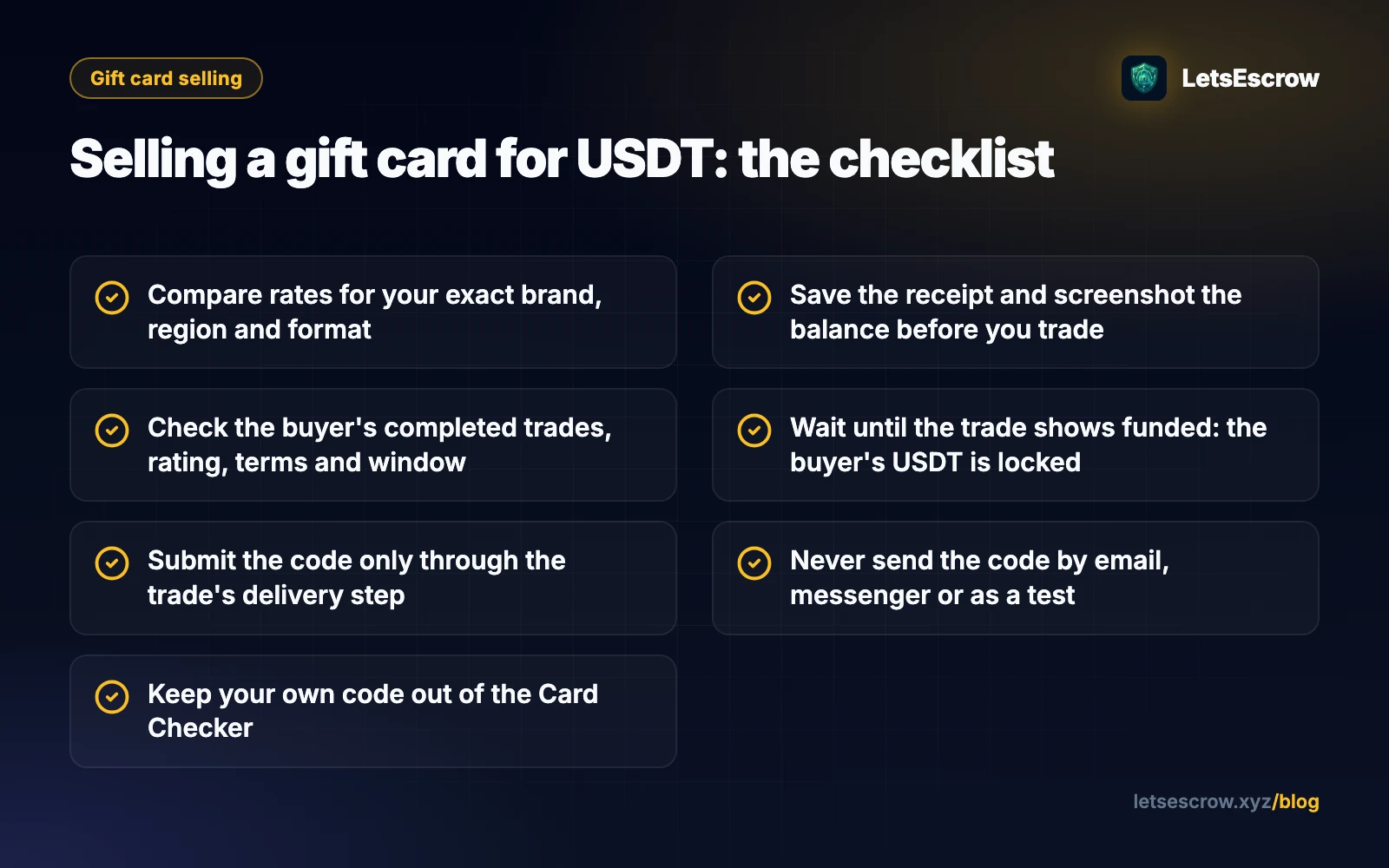
Once the trade shows as funded, you submit the code using the trade's delivery step, not in a private message. The code goes into the trade record, the buyer is told to check it, and the trade moves to review.
And the one absolute in this guide: never share codes outside the trade chat. Not by email, not in a messaging app, not as a "test". Anything outside the trade doesn't exist if there is a dispute.
Watch the window
Each listing sets its own countdown, from 5 minutes up to 24 hours, and it starts the moment the trade opens. You need to submit the code before it ends. If you don't, the trade cancels and the buyer's USDT goes back to them. Have the code ready before you open the trade.
The duplicate-code check: 2 possible notices, and 1 way sellers trip it themselves
When you submit a code, LetsEscrow compares it with codes from past trades, past trade chats and earlier lookups in its Card Checker tool. The comparison allows for spacing and format differences. The trade chat then shows the buyer one of two notices:
- Not seen before: the code has not appeared on the platform.
- Seen before: the code matches one used in an earlier trade or lookup, with the reference.
This is pattern matching against the platform's own history. It does not check the card's balance, and it cannot see codes used elsewhere. A clean, unused card you bought yourself should come back as "not seen before", and the buyer still has to redeem it to confirm the value.
One practical tip. Card Checker lookups are remembered, so if you paste your own code into the checker "just to see", a later trade can show it as seen before. The checker is a tool for buyers. As a seller, keep your code out of it.
If you want to see how the trade screen and the duplicate check look before you sell, run a practice trade in the simulator.
Picking a buyer: the 7-point checklist
The platform does not vet buyers, so read the profile and the listing before you open a trade.
- Completed trades. A count that only rises when trades finish.
- Rating and reviews. Only people who completed a trade with this buyer can leave one.
- Terms. Read them. Do they want a receipt, a photo, or a code in a specific format?
- Card format and region. Make sure they accept your exact card. A UK card sent to a US-only buyer is a dispute waiting to happen.
- Payment window. Is it long enough for you to submit the code calmly?
- Online now. A buyer shown as online was active in the last five minutes, which usually means a faster redemption check.
- Trusted by and blocked by. How many traders trust them, and how many have blocked them.
Buyer says the code is bad? 3 pieces of evidence that answer it
Sometimes a buyer says the code is invalid or has a zero balance. Sometimes they are right, through no fault of yours. Sometimes they are trying it on.
You can open a dispute at any point before release, and so can the buyer. The categories include an invalid or zero-balance code and a reported or locked card. Opening one freezes the trade, so neither side can cancel, and a moderator reviews the trade chat, the evidence and the timestamps. They can release the USDT to you, refund the buyer, or split it.
Your case is only as good as your evidence. Keep these before you sell:
- the purchase receipt, or the email the e-code came in,
- a photo of the physical card, front and back,
- a screenshot of the balance from the brand's own balance check, taken before you trade.
Post them in the trade chat if a dispute opens. Ask the buyer for a screenshot of their redemption error too. A moderator compares timestamps, so a balance check from an hour before the trade carries real weight.
Getting your USDT out: wallet, withdrawal, and TRC20 or BEP20
When the buyer releases, your USDT lands in your LetsEscrow wallet, minus your half of the platform fee. The fee is split evenly between buyer and seller, and the percentage is shown before you confirm the trade.
From there you can keep it for your next trade or withdraw it to your own wallet. Withdrawals carry a small fee, shown before you confirm, and staff process them and record the transaction hash.
USDT comes on two networks here: TRC20 (TRON) and BEP20 (BNB Smart Chain). They are the same token on different networks. Withdraw on the network your receiving wallet supports. If you were paid on the other one, you can swap between them one-for-one inside your LetsEscrow wallet first.
Worked example (illustrative): a $100 Amazon e-code at 82%
The names, rates and amounts below are invented to show the steps.
Ama in Accra has a 100 dollar US Amazon e-code she won't use. She compares a few buy listings and picks one offering 82% for US e-codes, with a 30-minute window, a long trade history and good reviews. The buyer is online.
- Prepare. Ama saves the email the code came in and screenshots the balance on the brand's own site.
- Open the trade. She opens a trade on the buy listing. 82 USDT plus the buyer's half of the fee locks from the buyer's wallet, and the trade shows as funded.
- Deliver. Ama submits the code through the trade's delivery step. The chat shows "not seen before".
- Release. The buyer redeems the card, sees the balance and releases. Ama's wallet is credited 82 USDT minus her half of the fee.
- Withdraw. She withdraws to her own TRC20 wallet and sees the withdrawal fee before confirming.
If the buyer had claimed a zero balance, Ama would have posted her balance screenshot and the original email in the chat, and the moderator would have weighed both sides.
FAQ
Can you sell unused gift cards for USDT, and at what rate?
Yes, if a buyer lists your brand, region and format. There is no single rate; it depends on the brand, region, format and current demand. Rates are a percentage of face value, so compare several live listings for your exact card before accepting one.
Is it safe to sell gift cards for USDT?
It is far less risky when the buyer's USDT is locked before you share the code and you share it only inside the trade. No method removes every risk, so keep your receipt and a balance screenshot as evidence.
Can a buyer reverse the trade after I share the code?
Not on their own. The buyer has no cancel button. Before release, their only route is a dispute, which a moderator decides on the evidence. Once they release, the USDT is credited to your LetsEscrow wallet.
Can I sell gift cards online without verification?
Without ID documents, yes, for everyday amounts: with only a confirmed email you can complete up to $1,000 of trades in any 30-day period by default. Higher limits open up with more verification, and staff can ask for it if a trade looks suspicious. "Instantly" is a different matter: the buyer still has to redeem the card and release.
Which gift cards sell fastest for USDT?
The brands with the most active buy listings move fastest, and that changes over time. Check the live listings for your brand, and the top 50 brands article above for a wider view of demand.
Ready to sell gift cards for USDT? See today's offers for Amazon cards, or open a free account and compare buyers for your own brand.
LetsEscrow is a peer-to-peer escrow marketplace, not a bank, law firm or licensed escrow agent. Check the rules that apply where you live.