Freelancer Escrow Service: Pay Only When the Work Shows Up (and the 5 Lines to Agree First)
Pay first and you carry the risk. Make them work first and they do. A freelancer escrow service locks the fee instead. How it compares with wires, invoices and platforms, and the 5 lines to agree first.
You found a developer through a social media post. Her portfolio is good, her rate is fair, and she wants half the money before she starts. You have not met her, there is no platform in the middle, and a bank wire has no undo button. This guide is about using a freelancer escrow service in exactly that spot: no upfront payment from you, no unpaid work from her, and a clear rule for when the money moves.
The method: you lock the fee before work starts, she delivers, and you release it when the work matches what you agreed. The rest of this article is about doing that well, because escrow for freelancers only works as well as the agreement behind it.
Pay first, work first or lock it: 5 ways to pay a freelancer, compared
When two strangers do a deal across a border, somebody usually has to go first. Both versions break in predictable ways, and often enough that the FBI counts them. In 2025 its Internet Crime Complaint Center logged 56,478 non-payment and non-delivery complaints, with $503,373,587 in reported losses (FBI IC3, 2025). The category covers both directions: work delivered and never paid for, and payment sent for work that never arrived.
If you pay first, you carry all the risk. The freelancer might deliver late, deliver half, or stop answering. When you pay freelancers overseas, a bank transfer or crypto payment to a private person is very hard to recover, and you have nobody to complain to.
If they work first, they carry all the risk. Plenty of clients take the files and go quiet, and plenty more simply pay late: 32% of UK freelancers surveyed by IPSE for Q1 2024 had a client delay payment in the previous 12 months (IPSE, 2024). Good freelancers know this, which is why the best ones you find outside a platform ask for money upfront. Their request is reasonable. So is your hesitation.
Escrow removes the question of who goes first. Your money is locked before work starts, so the freelancer can see it is real. You can't take it back on a whim, and they can't take it without delivering. If the two of you disagree, a moderator reads the record and decides. If you want the full mechanics first, read how P2P crypto escrow works, step by step.
Here is how the usual options compare, including where each one is perfectly fine.
| How you pay | Who carries the risk | If it goes wrong | Where it is actually fine |
|---|---|---|---|
| Upfront by bank wire or crypto | You | Hard to recover from a private person in another country | A freelancer you have hired before and trust |
| Friends-and-family app payment | You | Built for paying people you know, so purchase protection usually does not apply | A friend who happens to freelance |
| Work first, invoice after | The freelancer | They chase the invoice, or write it off | Long-standing clients with a clean payment record |
| A freelance marketplace platform | Shared, under the platform's rules | The platform's own dispute process | You found the freelancer there, or you need hourly billing or milestones, which LetsEscrow does not have |
| A freelancer escrow service (LetsEscrow) | Shared: the fee is locked and the release waits for you | Nothing marked delivered: the trade cancels and the fee returns. Otherwise a moderator can release, refund or split | Someone you found on your own, one deliverable at a time |
The verdict: a platform makes sense when you found the freelancer there or the job is billed by the hour. For someone you found on your own, escrow is the version where neither of you has to go first.

The 5 lines to agree before you fund (the 5th decides the release)
Most freelance disputes are not about fraud. They are about two people remembering a vague brief differently. Write these five lines before you fund, get a "yes" from the freelancer, and paste them as the first message in the trade chat.
- Scope. What is included, and what is not. "One landing page, up to six sections, contact form. No blog, no copywriting."
- Deliverable format. What you will receive and how. "A live preview link plus the theme files as a zip."
- Window. When it is due. A LetsEscrow trade's countdown runs for at most 24 hours, so each trade should cover work that can be handed over within a day of funding.
- Revisions. How many rounds of changes are inside this trade. "One round of small changes, requested within the window."
- What counts as done. The yes-or-no test you will use to release. "The page matches the approved mockup, loads on mobile and desktop, and the form sends to my email."
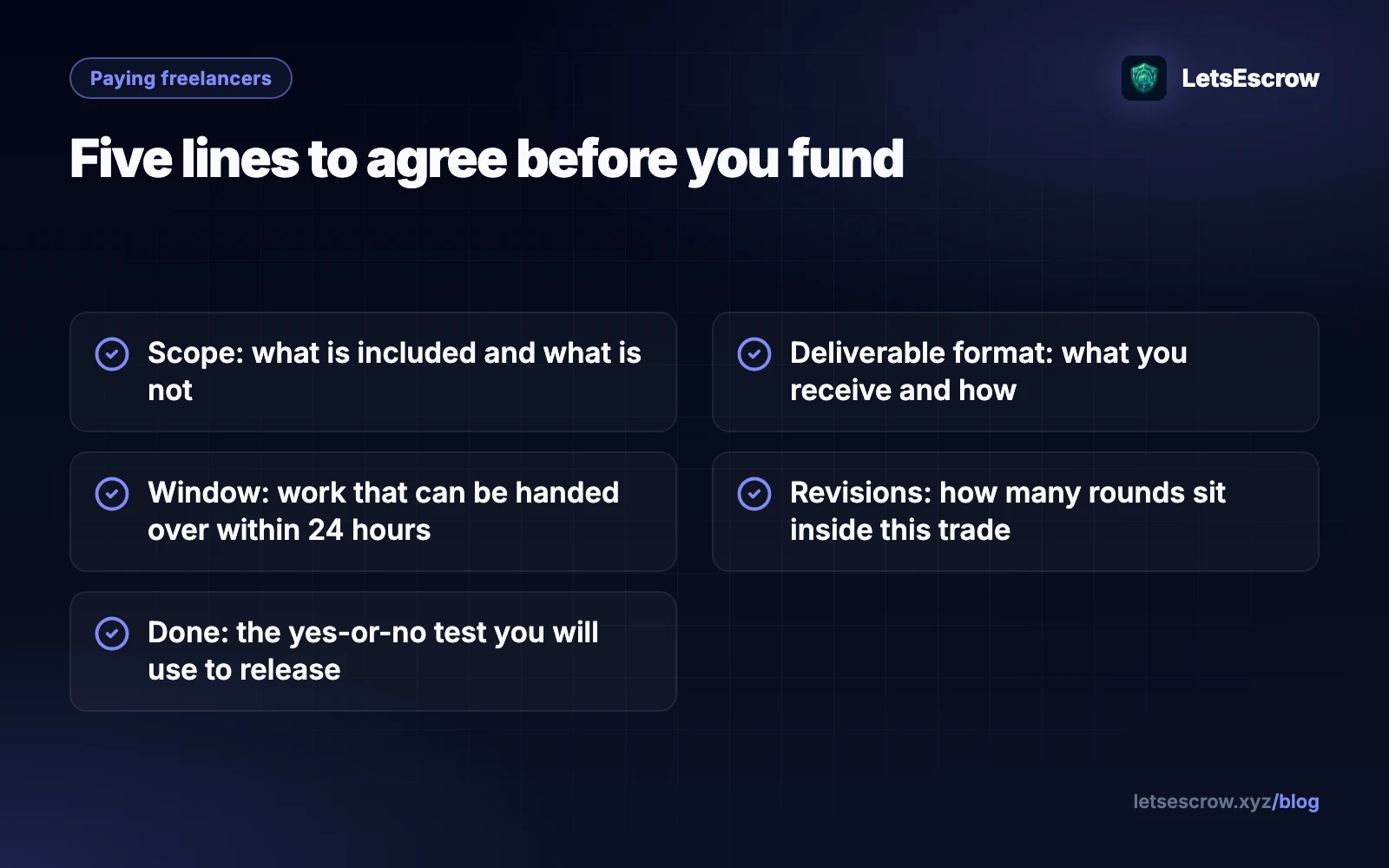
Most of knowing how to pay freelancers safely is knowing what you are paying for. The fifth line matters most. If you can't say in one sentence what "done" looks like, you are not ready to fund. A moderator can read your five lines and compare them with what was delivered. A moderator cannot read your mind.
Why the trade chat and not email? Because the trade chat is attached to the trade, timestamped, and it is what a moderator reviews in a dispute. Messages that share phone numbers, emails or messenger handles also get a visible warning and are flagged to staff, which helps keep the whole deal in one place.
Setting up the trade: 2 ways in, and the client funds both
There are two ways to start, and in both the client's crypto is what gets locked.
- The freelancer lists a service. She creates a service listing with a category, a description of deliverables and scope, a delivery timeframe, a price in her chosen currency, and a minimum and maximum amount. You open a trade on it.
- You post a hire listing. You describe the job and fund trades from your side. Because you are the one paying, your wallet has to cover at least the listing's minimum trade (plus your fee share) before it goes live, and the listing pauses if your balance later drops below that.
The category list covers most remote work: website design and full-stack development, app development, graphic design and UI/UX, content creation and video editing, digital marketing and SEO, virtual assistance, legal and accounting work, and more. If nothing fits, the Custom category lets you name it yourself, for example "Pitch deck redesign, 12 slides".
Listings can be priced in 26 currencies, including USD, EUR, GBP, INR, NGN and AED, so both of you can think in a familiar currency. You pay freelancers with crypto here, though: the money that is locked is USDT or Bitcoin. To see how other providers word their scope, browse web development listings that use escrow or graphic design listings.
One detail to understand early. A service listing shows a delivery timeframe in days, which is a guide. The countdown on the trade itself is what the platform enforces, and it maxes out at 24 hours. If the freelancer has not clicked "service delivered" when it ends, the trade cancels and your crypto goes back to your available balance.
Funding in 2 moves: deposit, then lock
Funding happens in two moves.
First, you deposit USDT (on TRC20 or BEP20) or Bitcoin to your LetsEscrow wallet. You submit the transaction hash, and once the deposit is confirmed and approved by staff it shows as available balance. Do this before the day you need it, since approval is a manual step.
Second, you open the trade. In one step the trade amount moves from your available balance to locked. The freelancer sees the trade as funded and can start without taking your word for anything. If your balance is too low, the trade does not open at all.
The platform fee is split evenly between you. Half is added to what you lock and half comes off what the freelancer receives. The percentage is shown on the trade screen before you confirm and is fixed at that moment. If you want to see that screen before using real money, practice a trade in the simulator first.
Delivery and release: test line 5, then press the button only you have
When the work is ready, the freelancer posts it in the trade chat (files, links or screenshots) and clicks "service delivered" with notes. The trade moves to review, and a system message tells you to inspect and then release or raise a dispute. Once delivery is marked, the countdown can no longer cancel the trade, so the freelancer is not racing the clock while you check.
Now check the work against your fifth line. Open the files. Click through the preview link on your phone. Test the form, then test it again from a different email address, because "it works on my machine" is not one of your five lines. If it passes, release.
Release is yours alone. The freelancer cannot release the money to themselves. When you release, their share goes to their LetsEscrow wallet, and both of you get a completed trade on your profiles. You can also require a 6-digit authenticator or email code before any release goes through, so nobody can release from your open laptop.
Be honest with yourself about one limit: once you fund, you cannot cancel. Only the freelancer can cancel a trade, which sends the money back to you. If you change your mind, your options are to wait for the window to run out (if nothing has been delivered), ask the freelancer to cancel, or open a dispute. So agree the five lines first, and fund only when you mean it.
Work misses the brief? 1 revision first, then 3 ways a moderator can end it
If the delivery misses your five lines, say so in the trade chat first. Many problems end with one revision.
If that fails, open a dispute. Either side can, while the trade is funded, delivered or under review. Pick the reason that fits, such as an unresponsive counterparty or "other" for work that misses the brief. The trade freezes, neither side can cancel, and a moderator reviews the chat, the files and the timestamps. They can:
- release the full amount to the freelancer, if the work matches what was agreed,
- refund you in full, if it clearly does not, or
- split the money by amount or percentage, if part of it was delivered.
The moderator judges the work against the agreement in the chat. They do not rate the design, and they cannot make bad work good. That is another reason your five lines should be specific and testable. There is no promised response time for disputes, so post your evidence early and keep it short.
Big job? There are no milestones, so it is 1 trade per deliverable
LetsEscrow has no milestone feature. One trade covers one deliverable and ends with one release. For anything bigger than a day's work, split the job into separate trades and open each one when that piece is about to start.
A website might become four trades: wireframes, homepage design, inner pages, then build and launch. Each one has its own five lines, its own window and its own release. At any point you have one deliverable at stake, and so does the freelancer.
If a deliverable runs a little over the window, the reopen option is a safety net. Either side can reopen an expired trade within the listing's reopen window (60 minutes by default) if the listing allows it and you still have the balance. Don't plan around it. Size each trade so it fits.
A freelancer escrow service in practice: 600 USDT, 3 trades, 1 silent contact form (illustrative)
The names and numbers here are invented to show the flow.
Tom runs a two-person skincare brand in Austin. He finds Aisha, a developer in Lahore, through a social media post. They agree on a landing page for 600 USDT. The work takes about three days, so they split it into three trades, each opened on the morning that piece starts. Aisha's service listing sits under Website Design & Full-Stack Dev with a 24-hour window.
- Trade 1, the mockup (150 USDT). Tom deposits USDT ahead of time, then opens a trade for 150 USDT. He pastes the five lines into the chat: one mockup for desktop and mobile, one round of changes, done means he approves it in writing. Aisha delivers that evening. Tom asks for a larger headline, she sends the revision, and he releases with his authenticator code.
- Trade 2, the build (300 USDT). Next morning Tom opens the second trade. Five lines again: a live preview link that matches the mockup on phone and desktop. Aisha posts the link that night and clicks "service delivered". Tom checks it on both screens and releases.
- Trade 3, form and handover (150 USDT). Done means the contact form sends to Tom's email and he has the theme files. Tom tests the form and nothing arrives. He says so in the chat. Aisha fixes a setting, the test email lands, and Tom releases.
At any point Tom had one day's fee at stake, and Aisha did not work a single day without the money for it already locked. If she had gone silent after a broken delivery, Tom would have opened a dispute and a moderator would have compared the five lines with what was delivered.
FAQ
Do I need to verify my identity to hire someone?
Not for everyday amounts. An account with a confirmed email can trade up to a default of $1,000 in completed trades over a rolling 30 days. Adding a phone number raises that, and further steps raise it again. Staff can ask for verification if a trade looks suspicious.
How do I get paid as a freelancer without working first?
Ask the client to open a trade on your listing before you start. A trade only exists once their crypto is locked, so an open trade is already funded, and you can see it. When you deliver and the client releases, the USDT or Bitcoin lands in your LetsEscrow wallet, minus your half of the fee.
What if they go silent after I fund?
If they have not marked the work delivered, the trade cancels when the window ends and your crypto returns to your available balance. If they marked it delivered but the delivery is empty or wrong, open a dispute and a moderator will review the chat.
Can I pay freelancers overseas in my own currency?
You can price and agree the job in your own currency, but the money locked in the trade is USDT or Bitcoin. LetsEscrow does not take card or bank deposits. If you only hold local currency, you can first buy USDT from another user through the crypto-for-cash marketplace.
Who pays the fee?
Both of you, half each. Your half is added to what you lock, and the freelancer's half comes off what they receive. The percentage is shown before you confirm and does not change during the trade. A coupon code, if you have one, can reduce it.
That is what a freelancer escrow service comes down to: neither of you has to go first. If you have someone in mind, ask them to list their service, or browse live listings to see how others scope their work. When you are ready, create a free account with an email address.
LetsEscrow is a peer-to-peer escrow marketplace, not a bank, law firm or licensed escrow agent. Check the rules that apply where you live.