How to Pay Dropshipping Suppliers: 3 Trade Sizes, 4 Layers of Proof, No Blind Transfers
Your supplier wants USDT before shipping. You want tracking before paying. How to pay dropshipping suppliers through escrow, how that compares with a wire, and what happens when 23 of 25 parcels ship.
You found a supplier through a dropshipping group on social media. The price is better than anything on the big marketplaces, the samples in the photos look right, and they want 300 USDT before they ship your first batch. No buyer protection, no platform, just a wallet address. This guide covers how to pay dropshipping suppliers safely in that situation: lock the money in escrow, tie its release to proof that goods moved, and keep control until they do.
The same method works for sourcing agents, private wholesalers and anyone else you pay to ship goods on your behalf.
The private-supplier problem: the best price, and no buyer protection
Search for the best way to pay overseas suppliers and most advice says "only buy through a large marketplace", because those give buyers some protection. But many good suppliers and agents work privately. They find clients on social media, quote in chat, and want payment in USDT because it is fast and works across borders.
From their side, asking for money first makes sense. They are buying stock and paying for shipping, and plenty of store owners disappear after the goods go out. From your side, paying a stranger's wallet is risky. If the batch doesn't ship, or ships short, there is nobody to complain to and no way to pull the crypto back. Supplier payments are a favourite target in general: in the AFP's survey of US treasury professionals, 76% of organizations experienced attempted or actual payments fraud in 2025, and fraudsters primarily impersonate vendors or executives to request changes to payment instructions (AFP, 2026).
Neither of you is being unreasonable. You just need a way to do the deal where nobody has to trust the other first.

Wire, direct USDT or escrow? What each one does when a supplier vanishes
With escrow, the order value is locked on LetsEscrow before the supplier ships anything. The supplier can see the trade is funded, because a trade cannot open unless the money is already locked. You keep the release, and only you can give it. The supplier cannot pay themselves.
So the supplier knows the money exists, and you know it will not move until you see proof. If you disagree about what arrived, a moderator reads the record and decides. If this is your first time, read how P2P crypto escrow works for the full sequence from deposit to withdrawal.
One thing escrow does not do: handle the goods. LetsEscrow holds the payment. The supplier ships, the carrier delivers, and you confirm. It is the same split of roles as when you pay a personal shopper abroad.
Compare that with the usual ways of paying a supplier. Money sent upfront is hard to get back once it has gone. The same AFP survey found that among US organizations hit by payments fraud in 2025, 30% recovered more than three-quarters of the lost funds and 20% recovered none (AFP, 2026). Business email compromise, a scam aimed at people who pay suppliers by wire, drew $3,046,598,558 in reported losses in the FBI's 2025 figures (FBI IC3, 2025).
| How you pay | Supplier sees the money before shipping? | If nothing ships | Where it is actually fine |
|---|---|---|---|
| Bank wire upfront | Yes, because it is already theirs | Usually final once it lands. Recalls happen, but they are not a plan | Long-standing suppliers whose bank details you have verified |
| USDT straight to their wallet | Yes, because it is already theirs | A crypto transfer cannot be pulled back by the sender | Suppliers with a long, clean history with you |
| Card or goods-and-services app payment | Yes, once they accept it | You can raise a dispute with your card issuer or the payment service, under their rules | Suppliers willing to accept it |
| A big B2B marketplace's order protection | Held under the marketplace's rules | The marketplace's own dispute process | Suppliers who sell through that marketplace |
| Escrow trade on LetsEscrow | Yes: it is locked, and only you can release it | Not marked delivered: the trade cancels and your USDT returns. Otherwise a moderator can release, refund or split | Private suppliers and agents you found on social media |
The verdict: if your supplier sells through a big marketplace with order protection, use it. Escrow is for the ones who don't, like the agent you met in a dropshipping group.
Sample, order or batch: 3 ways to size a trade
LetsEscrow has no milestone or partial-release feature. One trade covers one deliverable, and the payer releases it once. So the main decision is what one trade covers.
- Per sample. Your first trade with any new supplier. Small, cheap, shipped to you, so you can hold the product.
- Per batch. A day's or a week's customer orders shipped together. Fewer trades, more money in each.
- Per order. One trade per customer order. More admin, smallest exposure. Useful while trust is new.
Most store owners move from sample, to per order, to per batch as a supplier proves reliable.
Setting it up
The supplier or agent creates a service listing, and you open trades on it. There is no category called "dropshipping", so they usually pick "Any Item from Any Website" or Custom with a title like "Dropship fulfilment, tracked shipping". Listings can be priced in 26 currencies, including USD, GBP, EUR and INR, with a minimum and maximum amount. The money locked is USDT or Bitcoin. Live examples sit under dropshipping supplier listings and product sourcing listings.
You can also post your own hire listing describing what you need. As the payer, your wallet has to cover at least the listing's minimum trade before it goes live, and the listing pauses if your balance later drops below that.
A 24-hour window vs a shipment that takes weeks: how they fit
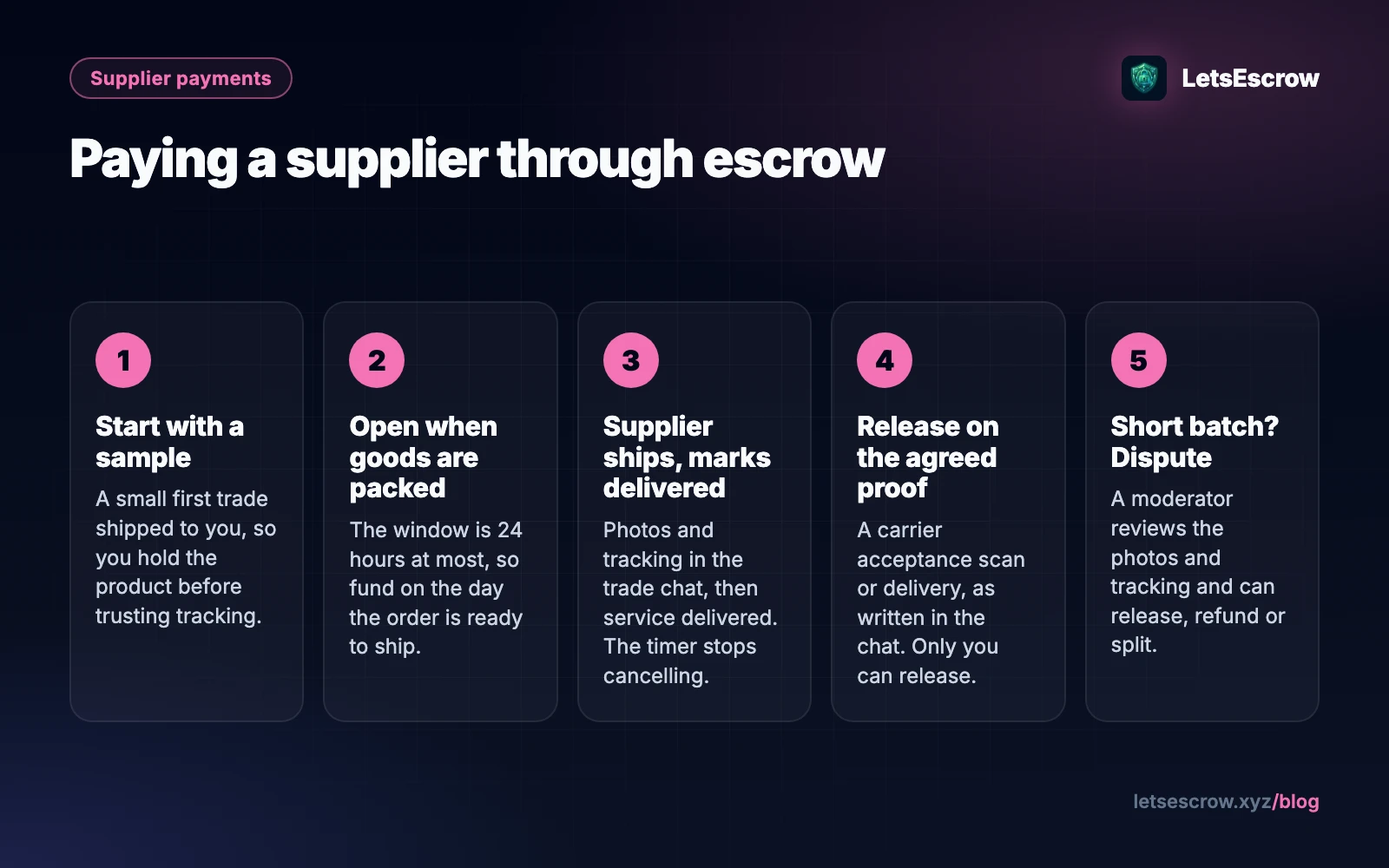
Each trade runs on a countdown the listing owner sets, from 5 minutes up to 24 hours. If the supplier has not marked the trade delivered when it ends, the trade cancels and your crypto goes back to your available balance.
Goods take days or weeks to arrive, so here is how the timer fits in practice. The supplier ships within the window, posts the tracking in the trade chat, and clicks "service delivered". From that moment the timer no longer cancels the trade. It waits for you to release or for someone to open a dispute. Nothing releases automatically.
This means timing your trade matters:
- Stock on hand: open the trade, and the supplier ships the same day.
- Made to order or sourced: agree to open the trade on the day the goods are packed and ready to go. Don't fund a week early, because the window will run out first.
The supplier who "will ship tomorrow" for the third week running is a familiar character. With this setup, the countdown simply hands your USDT back while you wait.
And one limit to know before you fund. As the payer, you cannot cancel a funded trade. Only the supplier can cancel it, which sends the money back to you. If you change your mind, wait for the window to run out (if nothing was marked delivered), ask the supplier to cancel, or open a dispute.
4 layers of proof before release (a label isn't a shipment)
Agree the release rule in the trade chat before the supplier ships. The chat is timestamped, takes image attachments, and is what a moderator reads in a dispute.
Ask for proof in layers:
- Photos before dispatch. The packed goods, labels visible, quantities countable.
- Tracking numbers posted in the chat, one per parcel.
- A carrier scan showing the parcel was accepted, not just a label created.
- Delivery confirmation on the tracking, or your own photos if it came to you.
When to release depends on trust. With a new supplier, release on delivery. Once a supplier has a track record with you, you might agree to release on the carrier's acceptance scan. Write whichever rule you choose in the chat.
In dropshipping the goods go straight to your customer, so delivery to your customer counts as delivery to you. You cannot inspect the item yourself, which is why the sample trade comes first: check the product once in your own hands, then trust the tracking for later orders.
If you want to see what the release and dispute screens look like, practice a trade in the simulator with no money.
Short or wrong batch: why 46 out of 50 ends in a split, not a shouting match
Problems with supplier orders are usually partial: 46 good units out of 50, two parcels with no scan, a colour mix-up. Because there is no partial-release button, a partial outcome goes through a moderator.
You or the supplier can open a dispute at any stage before release. The trade freezes and neither side can cancel. A moderator reviews the chat, the photos, the tracking and the timestamps, and decides one of three things: release the full amount to the supplier, refund you in full, or split it by amount or percentage.
A split fits supplier problems well. If the chat shows 50 units agreed and your photos show 4 broken, a moderator can pay for the good units and refund the rest. Even when you and the supplier agree on the numbers, there are two routes: a moderator split through a dispute, or the supplier cancels and you open a new trade for the corrected amount. The dispute keeps the money locked the whole time, so it is usually the cleaner choice. Either way, state the agreed numbers plainly in the chat.
What a moderator cannot do is judge whether a product is genuine or meets a quality standard nobody wrote down. Put specifics in the chat before shipping: material, size, colour, packaging, units per box.
Repeat orders: 4 habits that turn a good supplier into a routine
Knowing how to pay dropshipping suppliers safely the first time is half the job. The other half is making the next hundred orders easy once a supplier proves reliable.
- Mark them as trusted. Profiles show how many traders trust someone, so you add to their public record.
- Keep a standing terms message. Paste the same release rule and quality notes at the start of every trade.
- Watch both profiles grow. Each released trade adds a completed trade to both of you. A store owner with a long history is a client suppliers want.
- Block when it goes wrong. If a supplier cheats you, block them. Two users who have blocked each other cannot open a trade together.
How to pay dropshipping suppliers: 1 sample, 25 orders, 2 refunds (illustrative)
The names, prices and timings here are invented to show the steps.
Bronwyn runs a small homeware store from Manchester. Wei, a sourcing agent in Guangzhou, offers ceramic mugs at a good price and wants USDT. For Bronwyn, the safest way to pay a Chinese supplier she has never met is to lock the money rather than send it.
- Sample. Wei lists a Custom service, "Mug samples, tracked shipping", with a 24-hour window. Bronwyn opens a 40 USDT trade. Wei ships that day, posts the tracking and marks it delivered. The mugs reach Manchester and look right, so she releases.
- First batch. A week later Bronwyn has 25 customer orders. They agree 325 USDT, release on carrier acceptance scans. Wei confirms the parcels are packed, Bronwyn opens the trade, and Wei posts a photo, 25 tracking numbers and marks it delivered.
- A short batch. Two days later 23 parcels show a scan. Wei admits two were out of stock and did not ship. Bronwyn opens a dispute. The moderator reads Wei's message and splits: 23 orders' worth to Wei, 2 refunded to Bronwyn.
- Repeat. Bronwyn marks Wei as trusted. Later batches go through without incident.
FAQ
Can I use escrow for a $200 dropshipping order?
Yes, as long as it falls within the listing's minimum and maximum. Keep the account limits in mind if you order often. An email-only account can trade up to a default of $1,000 in completed trades over a rolling 30 days. Adding a phone number raises it, and more steps raise it again.
How do I verify a supplier before paying?
LetsEscrow does not vet suppliers. Every account has the same verification levels, starting with email-only Level 0, and staff can require verification if something looks suspicious, but that is about identity and trading limits, not a business check. Your supplier verification checklist is the profile (completed trades, rating, trusted-by count) plus a sample trade shipped to you.
What if the supplier ships but the goods are fake?
Don't release. Photograph what arrived, post it in the trade chat next to the agreed description, and open a dispute. The moderator decides on that evidence. This is also why you start with a sample.
Can I pay overseas suppliers in USDT from the UK?
The trade works the same wherever you are: lock USDT, the supplier ships, you release. Some listings limit which countries they trade with, so check the listing. How you record the payment for tax is a question for your accountant.
How do I handle recurring orders?
One trade per batch, a standing terms message pasted at the start of each, and the supplier marked as trusted. Start each trade on the day the goods are ready to ship.
If you already have a supplier in mind, ask them to list their service. Otherwise, browse live listings for sourcing agents and fulfilment, or create a free account to post what you need.
LetsEscrow is a peer-to-peer escrow marketplace, not a bank, law firm or licensed escrow agent. Check the rules that apply where you live.