How to Sell an Amazon Gift Card for Crypto: 6 Steps and the Question Most Sellers Forget
Selling an Amazon gift card for crypto comes down to the rate you accept and who redeems first. How region and format set the rate, four selling routes side by side, and where escrow fits.
You have a $150 Amazon card you will never use, and you would rather hold USDT. You are in large company: in a 2024 Bankrate survey of 2,373 US adults, 43% said they had at least one unused gift card, voucher or store credit (Bankrate survey, 2024). If you want to sell an Amazon gift card for crypto without losing the card or the money, two things decide how it goes: the rate you accept, and who redeems first.
Call it selling, converting or exchanging an Amazon gift card for crypto; the trade is the same. Everyone argues about the rate. Who redeems first is the part that decides whether you get paid, and on an escrow trade it has a clear answer. The buyer's crypto is locked before you share anything. You submit the code inside the trade, the buyer redeems it, and only then do they release. The rest of this guide covers the rate, how the usual selling routes compare, and what happens if something goes wrong.
Amazon cards: why a UK code is worth nothing to a US buyer
An Amazon gift card is generally tied to the Amazon store of the country that issued it. A US card loads onto a US Amazon account. A UK card loads onto a UK account. Canadian, German and other regional cards work the same way. A buyer who only shops on the US store can do nothing with a UK code, however valid it is. It is a perfectly good key to a house they do not live in.
So buyers say which regions they accept, and they price regions differently depending on what they can use. A card from a less common region may get fewer offers, or none at all on a given day.
Where the region shows up on a listing
On LetsEscrow, Amazon usually appears as one brand, so the region a buyer accepts lives in their listing terms. Read the terms before you open a trade. If they say "US only" and you hold a UK card, move on. A region mismatch is one of the most common reasons an Amazon trade ends in a dispute, and it is easy to avoid.
Before you open anything, confirm three details: the region printed on the card or in your purchase email, the currency of the face value, and the region in the buyer's terms. If any of them disagree, ask in the trade chat first or pick another buyer.

Physical card with receipt vs e-code: which one buyers pay more for
Gift card listings carry a card format badge: physical, e-code, or both. A physical card is the plastic card from a shop with a scratch-off code. An e-code arrives by email or in an app.
Buyers have reason to be careful about where a card came from. Gift cards are a common way for scammers to get paid: in 2024, 41,120 fraud reports to the US Federal Trade Commission named a gift or reload card as the payment method, with $212 million in reported losses (FTC Consumer Sentinel Data Book, 2024). No careful buyer wants to redeem a card with that kind of history.
That is why many buyers prefer a physical card with its purchase receipt. The receipt shows where and when the card was bought, which makes it less likely the card was paid for with a stolen card. E-codes are quicker to hand over but harder to trace back to a purchase, so some buyers pay a little less for them or skip them.
What buyers usually ask for
- A clear photo of the card, front and back, with the code area scratched.
- A photo of the receipt showing the store, date, time and amount.
- For e-codes, a screenshot of the delivery email or app screen showing the amount and region.
Share these as attachments inside the trade chat, not over a messaging app. The chat takes images, and anything posted there is visible to a moderator if a dispute comes up later.
How the rate is set, and why the highest number is not the best offer
Gift card listings are priced as a percentage of face value. A listing at 80% means a $100 card is worth $80 in crypto, converted to USDT or BTC at a live exchange rate, so the same listings let you sell an Amazon gift card for bitcoin or for USDT. Search "amazon gift card rate today" and you will find numbers everywhere. The ones that count are on live listings, because a buyer has actually committed to them.
The platform fee is split between the two of you. Half is added to what the buyer locks and half comes off what you receive. The percentage is shown on the offer before you confirm, and it does not change once the trade opens.
Rate is one line out of several. Check the whole listing before you accept:
- Rate (% of face value): what you get before your half of the fee.
- Region in the terms: a wrong-region card is useless to this buyer.
- Card format badge: physical, e-code or both.
- Min and max amount: your card's face value has to fit inside the range.
- Payment window: how long you have to submit the code before the trade auto-cancels.
- Completed trades and rating: how this buyer has behaved in past trades here.
- Written terms: receipt rules, photo rules, anything extra.
A rate two points higher from an account with no completed trades and vague terms is not obviously better than a slightly lower rate from a buyer with a long record and clear rules. Two extra points do not buy much if you spend them arguing about a balance.
Best place to sell an Amazon gift card for crypto: 4 routes compared
People search for the best place to sell an Amazon gift card for crypto as if it were one site. In practice there are four common routes, and each one puts the risk on a different person:
| Route | Who goes first | If the buyer says the balance is wrong | Honest verdict |
|---|---|---|---|
| A friend or relative who shops on that region's Amazon store | You hand over the code; they pay you as agreed | You sort it out between you | Often the simplest deal, if you trust them and they really use that store |
| A buyer from a social media group or DM | Usually you: the code goes out before any money arrives | Nobody to appeal to; your screenshots are the whole case | Workable only with someone whose record you already know |
| An instant-quote gift card website | You: you submit the code and the site pays after its own check | The site's own support and rules decide | Quick if you accept one fixed quote and trust the site to pay |
| An escrow listing on LetsEscrow | The buyer: their USDT or BTC locks before you share the code | A moderator reviews the chat, attachments and timestamps, then releases, refunds or splits | Suits selling to a stranger, at the cost of a split fee and a withdrawal step |
If a friend on the right regional store wants the card, sell it to them. For a stranger, the best place is one listing: the one where the buyer's funds are locked before your code moves and you can see how they have behaved before. Browse the gift card marketplace and sort through a few before you choose.
How to sell an Amazon gift card for crypto in 6 steps
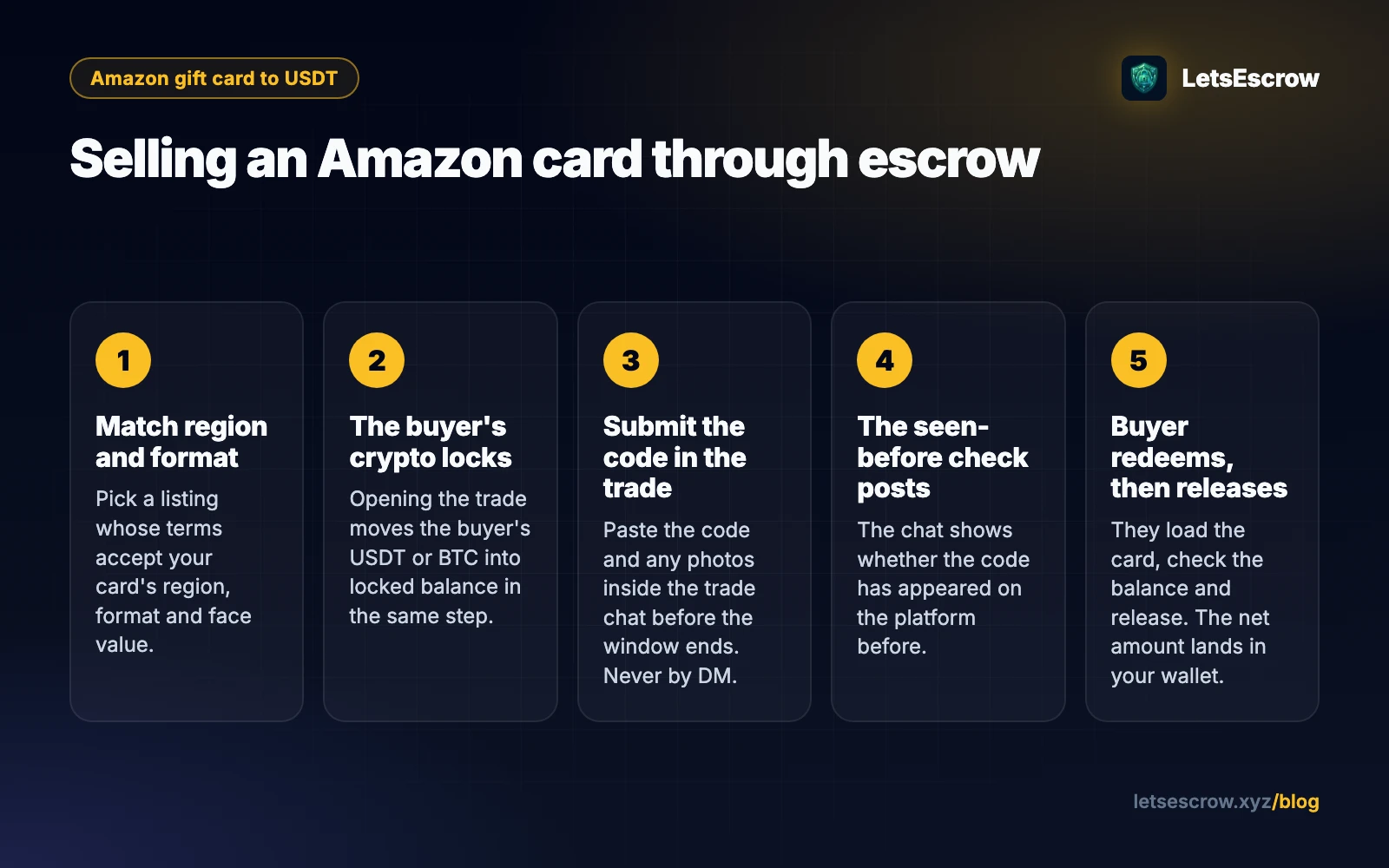
- Pick a listing that matches your card's region, format and amount. Read the terms.
- Open the trade. The buyer's USDT or BTC moves from their available balance into locked balance in the same step. If they do not have enough, the trade cannot open. An open trade means the money is there.
- Submit the code inside the trade before the window runs out, with any photos the terms ask for. If the window ends first, the trade auto-cancels and the buyer's crypto goes back to them, so have the code ready before you open.
- The duplicate check runs and posts a notice in the chat. More on that below.
- The buyer redeems the code into their own Amazon account and checks the balance.
- The buyer releases. Only the person whose crypto is locked, or a moderator, can release. When they do, the net amount lands in your LetsEscrow wallet.
Never share codes outside the trade chat. If a buyer asks for the code by email or on a messaging app "to save time", say no. The only time it saves is the time they would have spent paying. The general mechanics are in how P2P crypto escrow works, and the brand-agnostic version of this guide is how to sell gift cards for USDT safely. If you want to see the trade screen first, the no-money trade simulator walks through it.
Illustrative example: a $100 US e-code sold from Lagos
Obinna lives in Lagos and has a $100 US Amazon e-code from a relative abroad. He wants USDT. The numbers below are made up for the example.
- He filters the gift card listings for Amazon and finds a buyer whose terms say "US e-codes only, screenshot of delivery email required". The rate is 78%, the window is 30 minutes, and the buyer has a long list of completed trades.
- He opens the trade. About 78 USDT, plus the buyer's half of the fee, is locked from the buyer's balance.
- He pastes the code into the trade and attaches the email screenshot. The chat shows that the code has not been seen before.
- The buyer redeems it, sees $100 added to their US Amazon account, and releases.
- Obinna receives 78 USDT minus his half of the fee in his LetsEscrow wallet. He sells some for naira on the fiat tab and keeps the rest.
If the buyer had gone quiet after redeeming, Obinna would not need to chase them anywhere else. He would open a dispute from the trade page while the funds were still locked.
The "seen before" notice: what the buyer sees the moment your code lands
When you submit a code, LetsEscrow compares it against codes from past trades, past chat messages and earlier lookups in the Card Checker tool. The comparison is format-aware, so extra spaces, dashes or capital letters do not hide a match. It is pattern matching on the platform's own records. It does not contact Amazon and cannot tell anyone the card balance.
The trade chat then shows one of two notices:
- Not seen before: the code has not appeared on the platform. The buyer is still told to redeem and check the balance before releasing.
- Seen before: the code matched an earlier trade, chat message or Card Checker lookup, listed with a reference and who submitted it. The buyer is warned to redeem first and not to release on a zero balance.
A "seen before" notice is not proof of fraud. The check has a long memory, and that includes your own history. If you submitted the same card in a trade that later cancelled, or ran it through the Card Checker yourself, that shows up. Say so in the chat straight away. If you bought the card from someone else, keep in mind they may have sold it twice.
If the buyer says the balance is wrong: 4 pieces of evidence to keep
Sometimes a buyer reports that the code was already redeemed, shows a lower balance, or will not load on their account. A dispute can be raised by you or the buyer at any stage before release. The categories include an invalid or zero-balance code and a reported or locked card. Opening one freezes the trade, posts a notice in the chat, alerts the moderators and emails the other side. Neither of you can cancel a disputed trade.
Evidence to keep as the seller
- The receipt or purchase email, with date and time.
- Photos of the physical card, front and back.
- Your own screenshot of the code before you submitted it.
- Anything the buyer said in the chat about region or format before you submitted.
A moderator reviews the trade chat, attachments and timestamps and can release to you, refund the buyer, or split the amount. The buyer's side of the case is their redemption screen, with a time on it. There is no promised response time, so post your evidence early and keep every reply inside the trade. A screenshot posted in the chat counts. A screenshot you meant to take does not.
Cashing out: 3 ways to turn released USDT into money you can spend
Released crypto lands in your LetsEscrow wallet, not straight in an outside address. From there you have three options:
- Withdraw to your own wallet address. A withdrawal fee applies and is shown before you confirm. Withdrawals are processed by an admin, so do not plan around a fixed time.
- Swap inside the wallet: USDT between TRC20 and BEP20 at 1:1, or USDT to BTC at the live rate.
- Sell the USDT for local money on the fiat tab, with methods such as bank transfer, UPI, Zelle or Cash App. There the roles flip: your USDT locks, and you release once the money is in your account. The P2P bank transfer guide shows that flow from the other side.
Some people search for this whole process as buying USDT with an Amazon card. It is the same trade, and the buy USDT with an Amazon gift card page lists the same kind of offers. For brand details, see the Amazon gift card brand page.
FAQ
What is the Amazon gift card rate today, and where do I check it?
There is no single rate. It moves with region, format, card amount and demand, and the only numbers that count are on live listings, because a buyer has committed to them. Compare rate, terms, window and the buyer's completed trades. A slightly lower rate from a buyer with a long record and clear terms is often the better trade.
Where is the best place to sell an Amazon gift card for crypto?
For a stranger, wherever the buyer's crypto is locked before you share the code, you can see the buyer's completed trades and rating, and a moderator can step in if the balance is disputed. On LetsEscrow that is any Amazon listing whose terms match your card's region and format. If a friend you trust shops on the same regional store, selling to them directly can be simpler.
Can you sell Amazon gift cards for cash instead of crypto?
On LetsEscrow the buyer pays in USDT or BTC, which lands in your wallet on release. If you want local money, sell that USDT on the fiat tab for a bank transfer, UPI, Zelle, Cash App or another listed method, with the same escrow protection on that second trade.
Can I sell an Amazon gift card without a receipt?
Yes, if the buyer's terms allow it. Many e-code buyers accept a screenshot of the delivery email instead. Some physical-card buyers require a receipt and may offer less, or decline, without one. Check the terms before you open the trade.
How long does an Amazon gift card trade take?
Your part is quick: submit the code before the listing's window ends, which can be anywhere from 5 minutes to 24 hours. After that the buyer redeems and releases at their own pace. There is no fixed completion time, so favour buyers with a record of completed trades.
Can I sell a UK Amazon card to a US buyer?
Usually not. Amazon cards generally redeem only on the store of the country that issued them, so a UK card will not load onto a US account. Look for a buyer whose terms say they accept UK cards.
Why was my Amazon card flagged as seen before?
The code matched one from an earlier trade, chat message or Card Checker lookup, and that includes your own earlier attempts. The notice shows where it was seen. If it was you, explain in the chat. If you bought the card second-hand, the previous owner may have shared it before.
A drawer is not a savings account. In the same Bankrate survey, 34% said they had lost money through a gift card mistake, with 20% saying they had let a card expire and 17% saying they had lost one. If you have an Amazon card sitting in a drawer, start with a buyer whose terms you understand and a card whose region you have checked. See today's offers for Amazon cards, or open a free account and look around first.
LetsEscrow is a peer-to-peer escrow marketplace, not a bank, law firm or licensed escrow agent. Check the rules that apply where you live.