Buy For Me Service: 3 Ways Round 'We Don't Ship to Your Country', and the 1 That Needs Escrow
"We do not ship to this country." A forwarding address, a proxy company or a buy for me service can get round it. The 3 routes side by side, and how to pay a shopper abroad without sending money blind.
The running shoes you want are on a US store. You add them to the cart, type your address in Lagos, and checkout stops with the seven most deflating words in online shopping: "We do not ship to this country." The usual answers are a forwarding address, a proxy company, or a buy for me service: a person abroad who buys the item and posts it to you. This guide compares the three, then shows how to pay that person with the money held in escrow until the parcel is in your hands.
Buy for me service, proxy company or forwarding address: 3 routes, 3 different risks
You are far from the only one shopping across a border. In Eurostat's 2023 figures, 40.24% of EU residents who bought online in the previous three months had bought from sellers in other countries, and 20.05% from sellers outside the EU (Eurostat, 2023). There are three common ways to get an item from a store that won't send it to you. They suit different situations.
1. A forwarding address
A forwarding company gives you an address inside the store's country. You order to that address, then they repack the parcel and send it on to you. You pay the store yourself, plus the forwarder's fees and international shipping.
This works when the only problem is the delivery address. It fails when the store also rejects your card, blocks foreign visitors, or sells only in person.
2. A proxy buying company
A proxy company buys the item on your behalf, using its own payment method, and ships it to you. You pay the company the item price plus a service fee and shipping. This solves the card problem, but you are limited to the stores and countries the company covers.
3. A buy for me service (a personal shopper)
A personal shopper is an individual in that country who buys the item, sometimes from a physical shop, and posts it to you. They can do things a company won't: queue at a store, check sizing in person, buy a local-only item, or pack a gift with a note. The trade-off is trust. You are paying a stranger for goods plus their fee before anything ships.
| Forwarding address | Proxy company | Personal shopper, paid upfront | Personal shopper, paid through escrow | |
|---|---|---|---|---|
| Who pays the store | You | The company | The shopper | The shopper |
| Your card must work at the store | Yes | No | No | No |
| In-store or local-only items | No | Sometimes | Yes | Yes |
| If nothing ships | You take it up with the store or the forwarder | The company's refund terms | Hard to get back from a private person abroad | Not marked delivered: the payment returns when the window ends. Otherwise a moderator decides |
| Main risk | Card or store refuses you | Limited coverage | Paying a stranger first | The shopper still has to ship: escrow holds the money, not the parcel |
| Best when | Only the address is the problem | The store is one the company covers | You already know and trust the shopper | A stranger can do what a company won't |
For most people asking how to buy from a website that doesn't ship to their country, the store has also rejected their card, or the item is sold only locally. That points to the third route, the buy for me service. It is the most flexible, and it is the one where the way you pay matters most. If your card works and only the address is the problem, a forwarding address is usually the simpler choice.
Where a personal shopper abroad needs escrow: their money first, or yours?
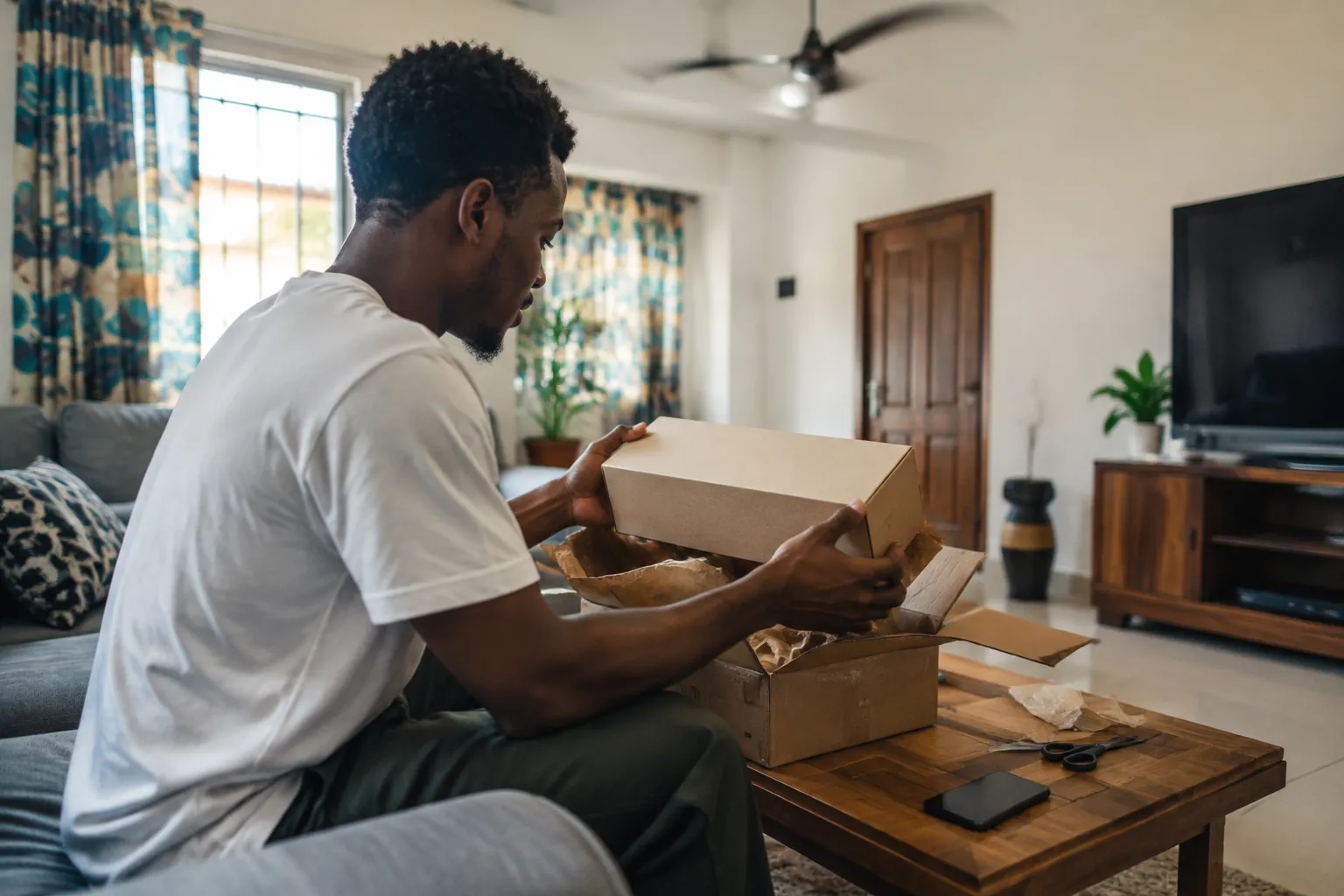
A personal shopper abroad is spending their own money on your item, so asking you to pay first is reasonable. Sending it is still a risk. A bank transfer or crypto payment to a private person is hard to get back if the parcel doesn't ship. And shopping is where people most often report losing money: in the FTC's 2025 data, online-shopping fraud was the most commonly reported category among US fraud reports where people said they lost money (FTC, 2026). That ranks the number of reports, not dollars lost.
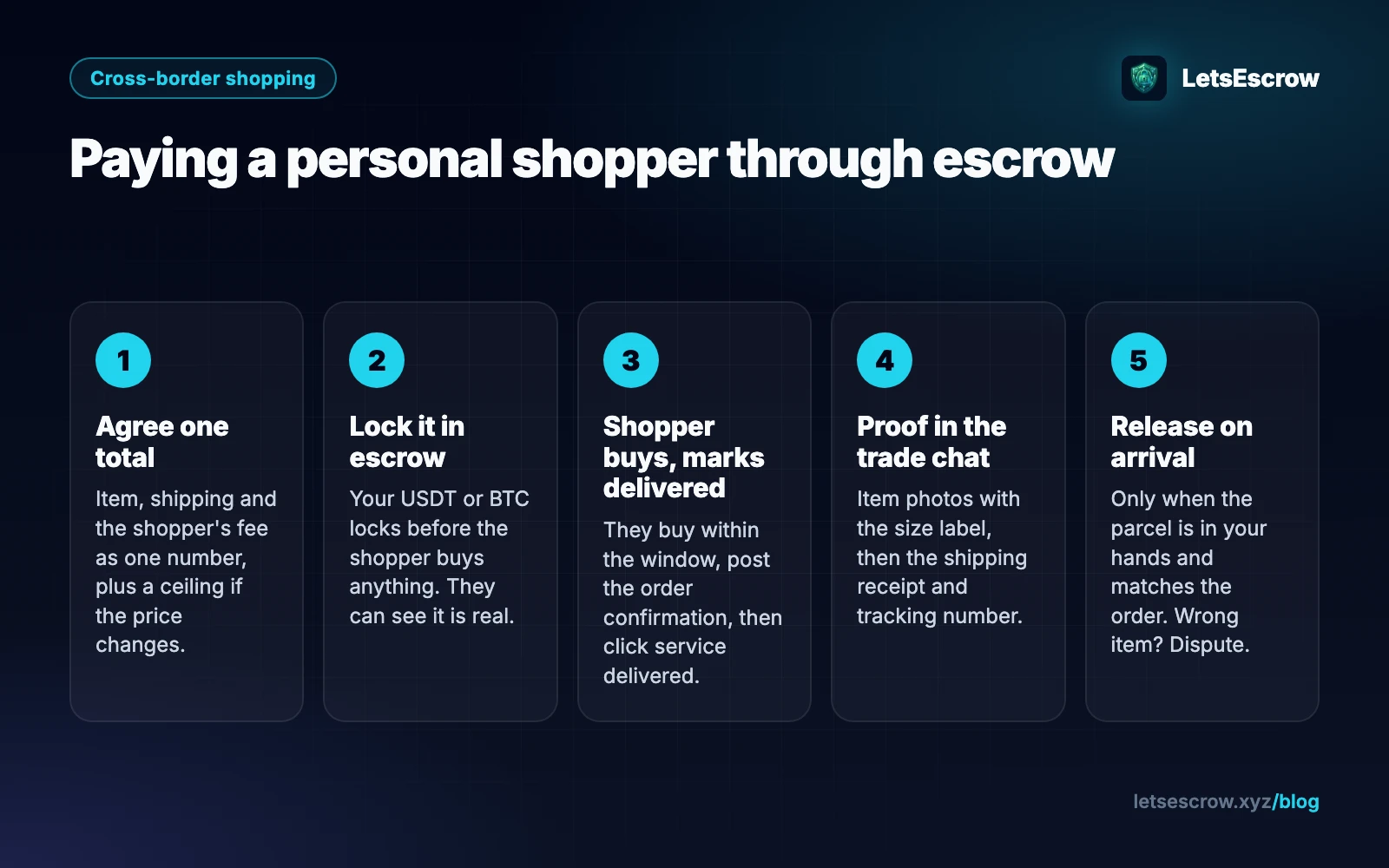
Escrow changes the order of events. Your payment is locked on LetsEscrow before the shopper buys anything. The shopper can see it is real, so they are not spending their money on a promise. You keep the release, so they are not paid until the item reaches you. Only you can release the money; the shopper cannot pay themselves. If you want the step-by-step mechanics, read how P2P crypto escrow works.
What escrow does not do is handle the parcel. LetsEscrow holds the payment. The shopper handles the goods. You confirm that they arrived.
Screening a shopper: 6 profile signals (none of them a background check)
Start with the personal shopping listings. Shoppers usually list under "Do Shopping", which covers personal shopping, order placement and store runs, or under "Any Item from Any Website". Most cover one country, so look for a buy for me service in the USA, the UK or Japan to match the store you want to buy from.
LetsEscrow does not vet shoppers. A profile shows how someone has traded on the platform, not who they are as a business. Read it like this:
- Completed trades. More is better, and the number only goes up when a trade is released.
- Rating and reviews. Only people who completed a trade with this shopper can review them.
- Trusted by and blocked by. How many users marked them trusted, and how many blocked them.
- Member since. A brand-new account with big claims deserves a small first order.
- Verification level. This reflects identity steps and trading limits. It is not a background check.
- Listing terms. A good shopper says which stores and countries they cover, how they charge, and how they ship.
If the shopper is new to you, start with one cheap item. A good first trade teaches you more than any profile.
Setting up the trade: 1 total, 5 details, 1 window
You can open a trade on a shopper's listing, or post your own hire listing describing what you need and let a shopper take it. Either way, your crypto is what gets locked.
Agree the price as one number
Add up the item price, the shipping cost to you, and the shopper's fee, and agree on a single total. Also agree a budget ceiling in case the price changes at checkout. "Up to 150 USD for the item. If it costs more, ask me first." A ceiling turns "the price went up a bit" into a question instead of a surprise. Your half of the platform fee is added on top when you lock, and the exact percentage is shown before you confirm.
Put the details in the first message
The trade chat is the record a moderator reads if anything goes wrong, so write the order there:
- The exact item link, plus size, colour and quantity.
- The budget ceiling for the item.
- The shipping method and the address it goes to.
- What the shopper posts as proof, and when.
- When you will release: once the parcel is in your hands and matches the order.
Use the window the right way
The listing owner sets a countdown on every trade, anywhere from 5 minutes to 24 hours. If the shopper has not marked the trade delivered when it ends, it cancels and your crypto goes back to your available balance.
Shipping takes longer than a day, so agree how the timer fits. The usual approach is that the shopper buys within the window, posts the order confirmation, and then clicks "service delivered". From that moment the timer no longer cancels the trade, and it waits for your release. You still hold the release until the parcel arrives. If the shopper does not buy in time, the trade simply cancels and you are back where you started.
This is the same discipline as hiring any remote professional. The guide to paying a freelancer without paying upfront covers how to write the agreement so the release decision is obvious.
4 kinds of proof before you release ("delivered" on a tracking page isn't one)
Ask for proof in the trade chat at each stage. The chat takes image attachments, and anything posted there is part of the record.
- Order confirmation showing the item, the price and the shopper's delivery address.
- Photos of the item once it reaches the shopper, with the size label or serial number visible.
- A shipping receipt and tracking number when it goes out.
- Your own photos when it arrives, ideally as you open it.
Delivery is where online orders most often wobble. In Eurostat's 2025 survey, 63% of EU online shoppers reported no problem, but 20% had slower delivery than expected and 10% received a wrong or damaged item (Eurostat, 2025). Those figures cover domestic and cross-border orders together.
Then release. Release only when the parcel is in your hands and matches the order. Tracking that says "delivered" is not the same as having the item. If you have turned on a release code, you will enter your authenticator or email code at this point.
If you want to see the release screen before you trade, try the trade simulator with no money.
Customs, returns, lost parcels: 3 things escrow doesn't touch
Be clear about the edges. LetsEscrow holds the payment and does not touch the goods. It does not ship, store, insure or inspect anything.
- Customs and import charges are between you and your country's customs service. Rules differ by country and by item, so check them before you order. Nothing here is customs or tax advice.
- Store returns usually need the original buyer, which is the shopper. Agree in the chat what happens if something has to go back.
- Lost or damaged parcels are a matter for the carrier and whoever bought the shipping.
What escrow does cover is the money. If the wrong item arrives, or it arrives broken, or nothing arrives, open a dispute while the trade is live. The trade freezes, and a moderator reviews the chat, the photos and the timestamps. They can release the full amount to the shopper, refund you in full, or split it. The clearer your first message and your photos, the easier that decision is.
Worked example (illustrative): 210 USDT of running shoes, New Jersey to Lagos
The people, prices and timings here are invented to show the flow.
Emeka lives in Lagos and wants running shoes from a US store that only ships within the US. He finds Dana, a shopper in New Jersey with a Do Shopping listing, a few dozen completed trades and good reviews. They agree on 210 USDT: 140 for the shoes, 45 for shipping, 25 for Dana's fee.
- Lock. Emeka already has USDT in his LetsEscrow wallet. He opens a trade on Dana's listing, which has a 24-hour window, and 210 USDT plus his half of the fee is locked.
- Order details. His first message gives the link, size US 10, the colour, a ceiling of 150 for the shoes, tracked shipping, and his release rule: on arrival.
- Purchase. Dana orders that afternoon, posts the confirmation and clicks "service delivered" with a note that tracking will follow.
- Proof. The shoes reach Dana. She posts photos with the size label showing, ships them, and posts the receipt and tracking number.
- Arrival. About two weeks later the parcel reaches Emeka. He tries the shoes on, posts a photo and releases. Dana's wallet is credited 210 USDT minus her half of the fee.
If the box had held a size 9, Emeka would have opened a dispute. The moderator would see "US 10" in his first message and the size label in the photos, and decide from there.
FAQ
How do I pay a personal shopper in another country?
Agree a total that includes the item, shipping and their fee. Then lock that amount in escrow in USDT or Bitcoin instead of sending it. The shopper buys and ships, and you release when the parcel arrives.
Can I buy from Amazon US from Nigeria?
Some items ship to Nigeria and many do not, depending on the item and the seller. When an item won't ship to you, a shopper in the US can buy it and send it on. Product sourcing listings are where people offer that. Check your import rules before you order.
What if the item arrives broken?
Don't release. Photograph the item and the packaging, post the photos in the trade chat, and open a dispute. A moderator can refund, release or split based on the evidence. Claims against the carrier are separate from the trade.
How long can the trade stay open?
Before the shopper marks it delivered, at most 24 hours, depending on the listing's window. After that the timer no longer applies, and the trade stays open until you release or someone opens a dispute. Nothing releases automatically.
How much does a buy for me service cost?
It varies by shopper and item. Expect three parts: the item price, shipping to you, and the shopper's fee, which may be flat or a percentage. Agree them as one total before you fund, and compare a few listings for the country you are buying from.
If you have an item in mind, browse live listings for shoppers in that country, or open a free account and post what you need.
LetsEscrow is a peer-to-peer escrow marketplace, not a bank, law firm or licensed escrow agent. Check the rules that apply where you live.